The Security Team’s Guide to Continuous Threat Exposure Management (CTEM)
By Sarai Cross
Abstract
- Exposure management helps security teams turn fragmented findings into decisions about which attack opportunities matter, what evidence supports the risk, and what should be fixed first.
- CTEM provides one way to organize that process across scoping, discovery, prioritization, validation, and mobilization.
- EASM, CNAPP, and automated penetration testing support different parts of the exposure-management lifecycle rather than replacing the program itself.
- Effective programs combine technical findings with asset, identity, threat, and business context, then verify that remediation actually reduces exposure.
- Tool selection should start with the point where the organization’s exposure-management lifecycle is weakest.
Security teams rarely lack findings. The challenge is deciding what an attacker can actually reach, which exposures create meaningful business risk, and what should be fixed first.
Exposure management brings discovery, context, prioritization, validation, ownership, and remediation into one continuous program. Rather than treating every CVE, misconfiguration, exposed service, weak identity path, or control gap as an isolated ticket, teams evaluate those conditions in context and prioritize the ones that create the most meaningful attack opportunity.
Continuous Threat Exposure Management (CTEM) is one way to structure that work. Gartner organizes CTEM into five stages: scoping, discovery, prioritization, validation, and mobilization. Its exposure-management reference architecture takes a complementary view, covering capabilities such as attack-surface assessment, vulnerability assessment, exposure prioritization, adversarial exposure validation, and remediation or mitigation.
For buyers, the key point is simple: exposure management is a program supported by multiple capabilities, not necessarily a single product.
| Dimension | Vulnerability management | Exposure management |
| Primary question | What vulnerabilities exist? | Which conditions create meaningful attack opportunity? |
| Typical context | Severity, asset, patch status | Reachability, exploitability, identity, business criticality, attack paths |
| Validation | Typically rescanning or reassessment; exploit validation varies | May add adversarial validation, attack-path testing, control validation, or runtime evidence |
| Outcome | Reduce vulnerability backlog | Reduce exploitable and business-relevant risk |
The CTEM lifecycle: five stages
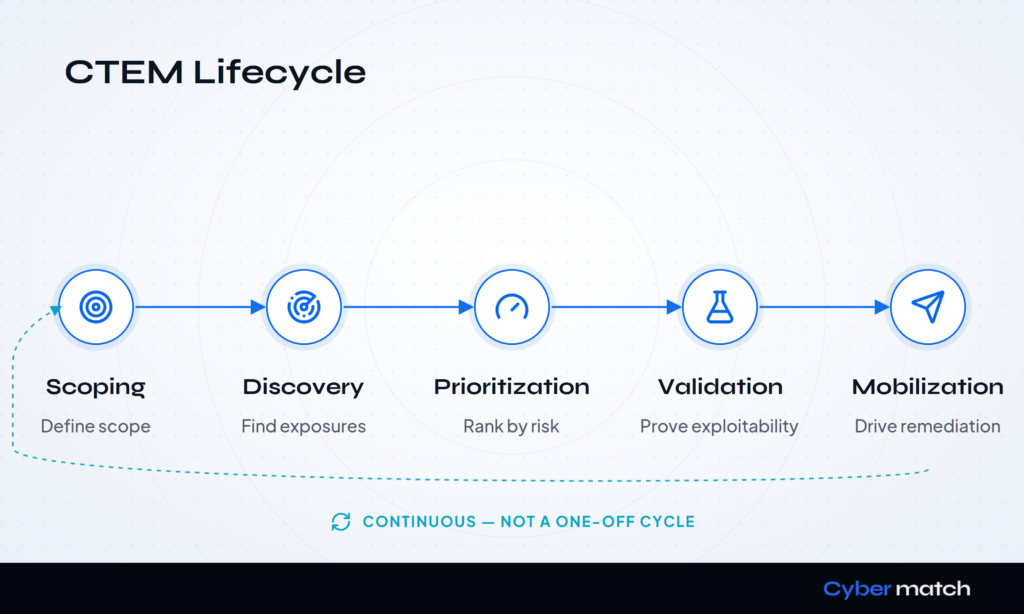
CTEM is commonly organized into five stages: scoping, discovery, prioritization, validation, and mobilization. IBM’s CTEM overview uses the same five-stage model. The sequence matters because discovery alone does not reduce exposure; findings still need context, validation, ownership, and action.
1. Scoping
Define which business services, assets, applications, identities, environments, or attack surfaces matter for the current cycle. A useful scope is tied to business risk, not simply to whatever a scanner happens to cover.
2. Discovery
Identify relevant assets and exposures across the selected scope. Discovery can draw from vulnerability scanners, EASM, CNAPP, API and application-security tools, endpoint telemetry, identity systems, cloud inventories, and other sources.
3. Prioritization
Correlate findings with context such as internet exposure, asset criticality, identity relationships, threat intelligence, CISA KEV status, EPSS, known exploitation, and attack-path position. The aim is to rank exposures by practical risk rather than raw severity alone.
4. Validation
Test whether the prioritized exposure can actually be used or whether the expected control is effective. Validation may involve automated penetration testing, breach-and-attack simulation, manual testing, runtime evidence, or other methods appropriate to the risk.
5. Mobilization
Get the right action to the right owner and track it to an evidence-based conclusion. That may mean patching, changing configuration, tightening permissions, removing an exposed asset, adding a compensating control, or formally accepting the risk.
Capabilities an effective exposure-management program needs
Asset and attack-surface awareness
Teams need a current view of what exists and where it is exposed. Static inventories struggle with ephemeral cloud assets, rapidly changing SaaS estates, newly deployed APIs, subsidiaries, and shadow IT.
Risk context
A finding becomes more useful when it is connected to environment, ownership, business criticality, reachability, identity, exploitability, known exploitation, and threat activity. Context is what separates an urgent exposure from an impressive-looking score.
Identity context is also becoming more complex as AI agents introduce new non-human identities, permissions, and access paths. Security teams need to understand what those agents can access, which credentials or integrations they rely on, who owns them, and how their actions affect the broader exposure picture.
Correlation and prioritization
Multiple products may report the same underlying condition. Deduplication and correlation reduce alert multiplication and help teams reason about attack paths rather than individual findings.
Ownership resolution
Exposure reduction depends on accountability. Asset tags, repository ownership, cloud metadata, service catalogs, and organizational directories can help map findings to the teams capable of fixing them.
Remediation workflow
Security findings need to enter the systems engineering and operations teams already use, with enough context to make the required action clear. Ticket creation alone is not a remediation strategy.
Validation and feedback
Closing a ticket is not the same as reducing risk. Strong programs verify that the fix reached the relevant environment, confirm that the attack path or exposure no longer exists, and feed that result back into prioritization. Security evidence also changes over time. New intelligence can change how an existing observation should be interpreted, which is why some teams continuously re-evaluate security evidence as intelligence changes rather than treating earlier assessments as permanent.
Why CVSS alone is not enough
A CVSS Base score is useful for describing the technical severity of a vulnerability, but severity is not the same as exposure. Two vulnerabilities with similar severity can create very different risk depending on whether the affected asset is internet-facing, whether exploitation is occurring in the wild, whether the vulnerable component is reachable, and what an attacker gains after exploitation.
EPSS can add another signal by estimating the probability that exploitation activity for a published CVE will be observed in the wild over the next 30 days, using a model that FIRST updated in June 2026 with changes to exploit-code detection, calibration, and other inputs. EPSS still should not be treated as a standalone priority score: business impact, asset context, exposure, compensating controls, CISA KEV status, and attack-path evidence remain relevant.
Which security tools support exposure management?
One platform does not need to perform every CTEM function. Many organizations build exposure-management capabilities from products they already own. What matters is which parts of the lifecycle each product covers well, how reliable its evidence is, and how effectively it connects discovery to remediation.
| Technology category | Contribution to exposure management | Where it fits best |
| External Attack Surface Management (EASM) | Outside-in discovery of internet-facing assets, ownership attribution, external exposure monitoring, and prioritization. | Best when the problem is unknown or unmanaged external assets. |
| CNAPP | Cloud asset inventory, CSPM, workload and container risk, entitlement context, build-to-runtime correlation, and cloud attack paths. | Best when cloud context and relationships drive risk. |
| Automated Penetration Testing | Exploit validation, attack-path chaining, repeatable testing, and evidence of what an attacker can achieve. | Best when teams need to validate exploitability rather than rely only on scanner findings. |
| API / Application Security | Application and API discovery, code and runtime weaknesses, business-logic flaws, and SDLC integration. | Best when application-layer exposures are a major part of the attack surface. |
| Endpoint / Identity / other controls | Additional telemetry, control enforcement, identity relationships, or compensating controls. | Often contributes context or mitigation rather than acting as the exposure-management system of record. |
Explore Exposure Management Categories on Cybermatch
If you are mapping out your exposure management stack, evaluate vendors across these primary categories using Cybermatch’s category-specific criteria:
- External Attack Surface Management (EASM): Discover and monitor internet-facing assets and perimeter risks. Browse EASM Vendors →
- Cloud Native Application Protection Platforms (CNAPP): Analyze cloud workload, entitlement, and configuration risks. Browse CNAPP Vendors →
- Automated Penetration Testing: Validate exploitability and test attack path viability continuously. Browse Automated Pen Testing Tools →
Five exposure-management mistakes that create more work, not less
1. Prioritizing by severity alone
Why it fails: severity does not tell you whether the issue is reachable, exploitable, business-critical, or part of a viable attack path.
Better approach: combine technical severity with exposure, threat intelligence, CISA KEV status, EPSS, asset criticality, identity context, and validation evidence.
2. Treating asset inventory as static
Why it fails: cloud resources, APIs, subsidiaries, SaaS, and external services change faster than periodic inventories.
Better approach: use continuous discovery and ownership attribution appropriate to the environment you are protecting.
3. Buying “one platform” before defining the problem
Why it fails: exposure-management products overlap with vulnerability management, EASM, CNAPP, validation, and workflow tooling in different ways.
Better approach: identify which lifecycle stages are currently weak, then compare products against those gaps.
4. Sending raw findings straight to engineering
Why it fails: a scanner export rarely explains business relevance, ownership, the affected service, or the expected fix.
Better approach: route a smaller number of contextualized, actionable findings into existing engineering workflows.
5. Measuring ticket closure instead of exposure reduction
Why it fails: a merged pull request or closed Jira issue does not prove the vulnerable condition is gone from production.
Better approach: validate fixes with rescans, deployment evidence, runtime telemetry, or repeatable attack validation.
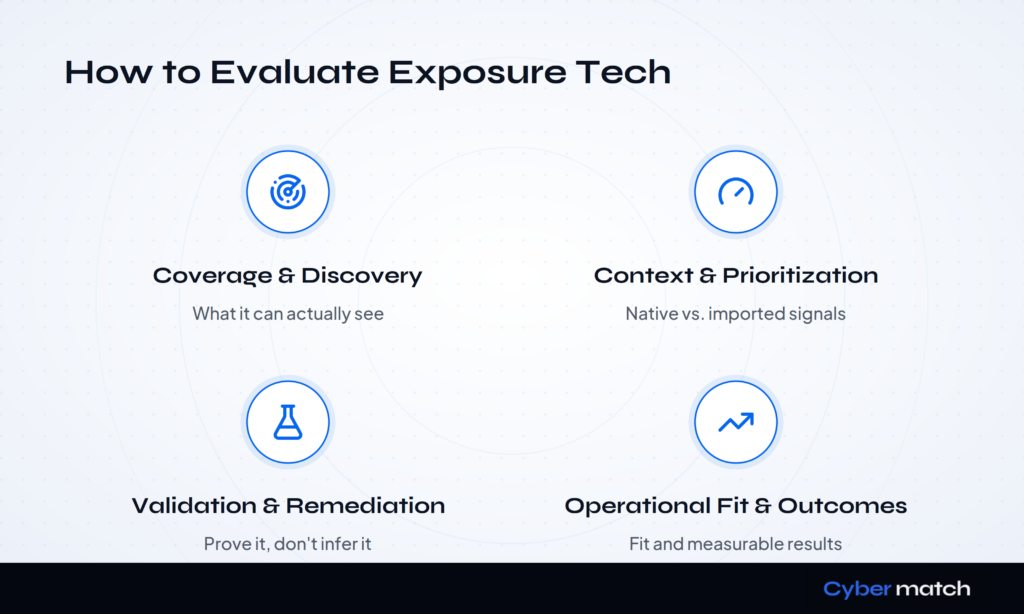
How to evaluate exposure-management technology
Feature lists often obscure meaningful differences between exposure-management products because vendors can use the same label for very different capabilities. Start with the evidence a product collects, the context it adds, and the decisions or actions that evidence can support.
Coverage and discovery
Define what the product can actually discover: assets, identities, applications, cloud resources, external services, vulnerabilities, misconfigurations, and relationships. Check what depends on integrations, agents, cloud APIs, scanners, or third-party data.
Context and prioritization
Look at how the product normalizes findings, resolves assets, maps relationships, and connects multiple observations to one underlying exposure or attack path. Ask which prioritization signals are native versus imported, including internet exposure, exploit intelligence, EPSS, CISA KEV status, business criticality, reachability, identity privileges, compensating controls, and attack-path position.
Validation and remediation
Determine whether the platform only infers risk or can actively validate exploitation, attack paths, or controls. Check whether validation is safe for production, how often it can run, and what evidence it produces. Then assess whether findings can be mapped to responsible teams, routed into operational systems such as Jira, GitHub, ServiceNow, or Slack, and verified after remediation.
Operational fit and outcomes
Evaluate deployment model, integration work, tuning, false-positive management, ongoing administration, and the skills required to keep the system useful. Also ask whether the platform can demonstrate measurable risk reduction through metrics such as exposure backlog by risk tier, remediation time, validated attack paths removed, recurrence rates, coverage, and the percentage of priority exposures resolved.
Build the shortlist around your weakest lifecycle stage
Instead of asking which exposure-management platform has the most features, ask where your exposure-management loop currently breaks.
- If discovery is the problem, start with EASM and discovery coverage so you can establish what is actually exposed to the internet.
- If cloud context is fragmented, evaluate CNAPP platforms that can connect configuration, workload, entitlement, and data context.
- If exploitability is unclear, look at automated penetration testing or other validation approaches that can distinguish theoretical findings from conditions an attacker can actually use.
- If ownership and remediation are the bottleneck, prioritize workflow integration, asset-to-owner mapping, and verification over additional detection volume.
- If one platform claims broad lifecycle coverage, test the depth of each capability rather than assuming breadth equals integration.
Exposure management should end in less exploitable risk
A mature exposure-management program should reduce exploitable risk, not simply produce a larger inventory of vulnerabilities. The program should repeatedly identify the attack opportunities that matter, validate them with appropriate evidence, assign the right action, and confirm that the exposure has been reduced.
Doing that usually requires several capabilities working together: attack-surface visibility, vulnerability and configuration data, contextual prioritization, adversarial validation, ownership, remediation workflow, and feedback. The right product mix depends on what your security program already does well and where teams still rely on manual triage, spreadsheets, or one-off scripts.
Compare categories and capabilities, not just vendor claims. Cybermatch helps security teams evaluate cybersecurity products side by side using transparent, category-specific criteria, so you can build a shortlist around the capabilities your program actually needs.