Reading time: ~14 minutes | Last updated: April 2026
TL;DR
- AI-SPM is not one product category; it spans identity governance, API security, and cloud posture. The right tool depends on where your actual risk sits.
- This guide covers 11 vetted solutions with honest assessments of strengths and limitations, plus verified user reviews from G2 and Gartner Peer Insights.
- Jump to the Quick Comparison table to find your starting point, or scroll to How to Choose for a decision framework.
AI usually breaks quietly. More often, it drifts into risk unnoticed: an agent gets broader permissions than intended, a retrieval layer surfaces sensitive data, or a copilot connected to live systems quietly expands the blast radius of a single weak control.
If you are adopting AI quickly, that kind of silent exposure is exactly what makes security teams uneasy. IBM’s 2025 Cost of a Data Breach Report found that 13% of organizations reported breaches involving AI models or applications, and 97% of those organizations lacked proper AI access controls.
For most teams, AI Security Posture Management is not a single technical layer. It sits across identity, APIs, cloud posture, and governance. The practical goal is simple: help you see where AI is being used, understand what it can access, and reduce the paths that can turn AI adoption into a security problem.
Below, we cover the ten strongest options in the market right now, what they actually do well, what reviewers flag as limitations, and which problem profile each one fits best.
What is AI Security Posture Management?
AI-SPM tools help security teams discover, assess, and govern the systems around AI use. The label is still evolving, but the operational need is already clear. Most buyers evaluating AI-SPM tools are really looking for a mix of: AI asset discovery, non-human identity governance, API protection, posture monitoring, runtime analytics, and policy enforcement.
In practice, that usually means continuously answering a few hard questions:
- Which AI-connected assets exist: agents, service accounts, tokens, APIs, connectors, and workloads?
- What do they have access to, and is that access still appropriate?
- Where is risk accumulating through excessive permissions, exposed endpoints, stale credentials, undocumented integrations, or cloud misconfigurations?
3 Types of Tools That Make Up AI-SPM
1. Non-human identity and access governance
The identity layer. These tools discover and govern service accounts, workload identities, AI agents, tokens, keys, and certificates. They matter because many AI risks are entitlement problems in disguise; an over-privileged agent is a much bigger threat than a vulnerable one.
2. API and application posture controls
Most AI features reach production through APIs, plugins, model gateways, and application backends. API security tools help discover exposed interfaces, compare live behavior to specs, detect logic abuse, and identify AI-specific issues such as data exfiltration via AI-integrated endpoints.
3. Cloud posture and attack-path correlation
AI systems inherit risk from the environments they run in. Misconfigured storage, exposed workloads, over-privileged cloud identities, and risky trust relationships all become AI security issues when they touch model pipelines, datasets, or automation. That is where CNAPP-style risk correlation becomes relevant.
Quick Comparison: Find Your Starting Point
| Vendor | Best For |
|---|---|
| FireTail | Purpose-built AI-SPM: discovery, governance, shadow AI |
| Clutch Security | AI agents and non-human identity (NHI) governance |
| Apono | Just-in-time and just-enough access for humans, machines, and AI agents |
| Saviynt | Enterprise-scale machine identity governance (IGA) |
| CyberArk | Entitlement governance and least-privilege automation |
| Teleport | Infrastructure and machine access governance |
| Veza | Access visibility across fragmented, multi-system environments |
| Salt Security | AI-enabled API posture and runtime abuse detection |
| Cequence Security | Bot, ATO, and business-logic abuse on AI-facing APIs |
| Sweet Security | Runtime-aware cloud risk and workload protection |
| Wiz | Cloud attack-path correlation, code-to-runtime visibility |
Shortlisting vendors? Cybermatch lets you compare these tools side by side using consistent, buyer-focused criteria so you can cut through the noise and find the right fit for your environment.
Top 11 AI Security Posture Management Solutions
1. FireTail
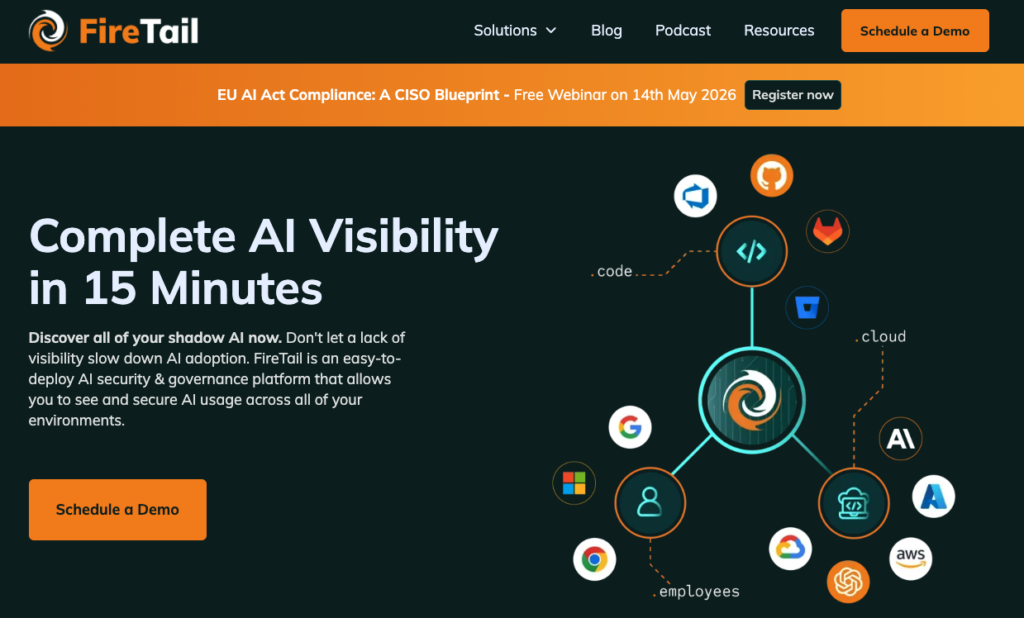
FireTail is the strongest direct fit for AI-SPM in this list. Its platform is purpose-built around AI security posture, AI governance, centralized AI logging, AI testing, and shadow AI discovery, not bolted onto an adjacent product. It emphasizes fast inventory creation across code, cloud, and users, policy-based governance, and continuous threat detection across the AI stack, including PII exposure and prompt-injection risks. Deployment is measured in minutes, not weeks.
Best for: Teams that want a dedicated AI security platform and need fast time-to-value. FireTail’s strength is visibility first: discover AI usage, map exposure, apply policy, and monitor for threats — all from one place.
Worth knowing: FireTail is a newer, focused platform. Organizations that need deep enterprise identity lifecycle management or CNAPP-level cloud coverage alongside AI-SPM will likely need to complement it with another tool.
Review: “The platform took just minutes to deploy, and within that short time, we had full visibility into our AI ecosystem, from internal models to third-party integrations. The centralised logging and AI security posture management gave us confidence that any risks are detected and addressed in real time. Automated testing and governance tools make it easy to enforce security standards without slowing down innovation.”
2. Clutch Security
Clutch Security is built specifically around non-human identities, service accounts, workloads, automation tokens, and AI agents. Its proprietary Identity Lineage enriches each NHI with context: origin, ownership, storage location, consumers, and accessed resources. The platform covers the full lifecycle: discovery, posture and risk management, least-privilege enforcement, and real-time anomaly detection. Its Zero Trust model promotes ephemeral identities, which render compromised NHIs useless to attackers even if credentials are exposed.
Best for: Organizations where AI risk is primarily an agent and machine identity problem. If your concern is over-privileged agents, stale automation credentials, or unclear machine ownership at scale, Clutch is the most direct fit in this category.
Worth knowing: Clutch is a specialist platform — it does NHI security exceptionally well, but does not cover API posture, cloud attack-path correlation, or broader CNAPP capabilities. Plan to pair it with other tooling for full coverage.
Review: “Clutch discovers and prioritizes risks based on identity context and lifecycle, offering out-of-the-box remediation plans to accelerate security posture and ensure full protection. It continuously monitors NHIs and analyzes behavior and access patterns over time to detect any unusual activity or deviation from established baselines.”
3. Apono
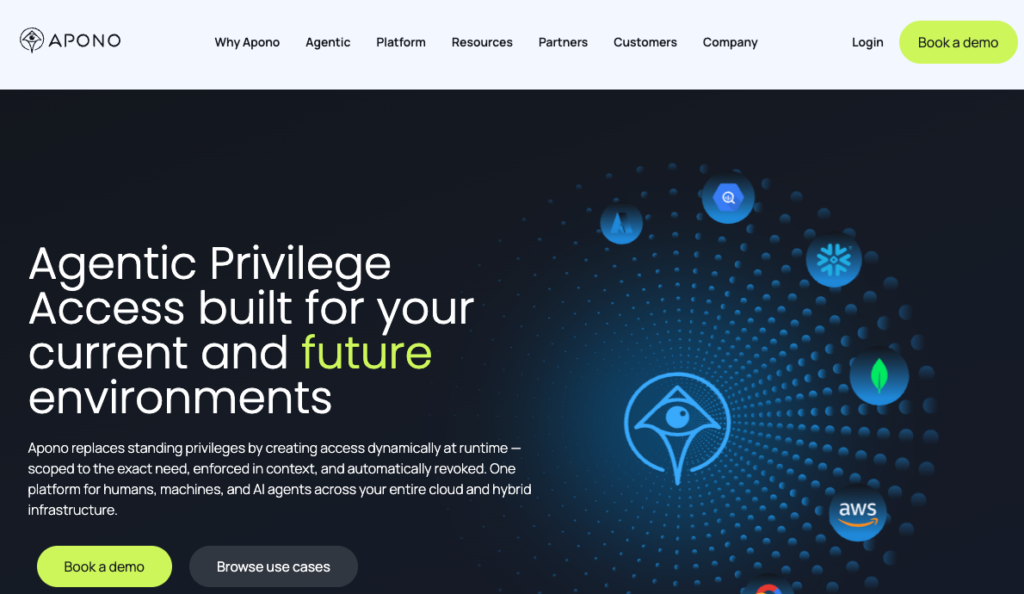
Apono is a cloud-native privileged access platform built to eliminate risky standing privileges across human engineers, machine identities, and AI agents. Instead of relying on pre-provisioned roles, Apono grants dynamic, time-bound permissions at request time, scoped to the specific task and enforced through provider-native controls across AWS, Azure, GCP, Kubernetes, databases, and other connected systems.
For AI-SPM use cases, Apono’s Intent-Based Access Control layer adds runtime guardrails for agent access. AI agents must request access based on what they are trying to do, and Apono evaluates that intent against the sensitivity of the requested privilege in real time. Low-risk actions can move forward automatically, while sensitive or misaligned requests can require human approval before access is granted. Access is automatically expired once the approved window or workflow ends.
Engineers can request access through Slack, Teams, CLI, or Jira, keeping developer workflows fast while least privilege remains enforced.
Best for: Organizations that need just-in-time and just-enough access governance across human, machine, and AI identities, especially where AI agents are being deployed into production infrastructure and standing credentials create unacceptable risk.
Worth knowing: Apono is strongest in cloud-native and hybrid environments. Organizations with a heavy legacy on-prem footprint should validate coverage before treating it as a full traditional PAM replacement. Teams looking for API posture management, vulnerability remediation, or cloud attack-path correlation may still need dedicated tooling alongside Apono.
Review: “Apono eliminated delays and excessive privileges. Everyone who needs access can get it very easily, and we really reduced the amount of overprivileged accounts that we had.” — Yaron Blachman, CTO & CISO, OpenWeb
4. Saviynt
Saviynt fits best when AI-SPM is being approached through enterprise identity governance. Its Identity Cloud covers certificates, keys, service accounts, bots, containers, and APIs with lifecycle controls for issuance, renewal, decommissioning, and revocation built in. Risk-based access certifications and audit-ready reporting make it particularly strong for regulated industries. Saviynt has been named a Gartner Peer Insights Customers’ Choice for IGA for four consecutive years, earning a 4.8 out of 5 rating across 185 reviews in the most recent cycle.
Best for: Large enterprises that want AI-related machine identity governance folded into an existing IGA operating model, rather than adopting a separate AI-specific platform.
Worth knowing: Saviynt has a steep learning curve and typically requires dedicated implementation resources. Several reviewers note that support quality has been inconsistent, and custom connectors sometimes need significant additional work.
Review: “Saviynt EIC has been fundamental in the modernization of our identity management, facilitating the migration of our on-prem infrastructure to the cloud. It required zero development to get started, and the cloud-native architecture made our transformation significantly smoother.”
5. CyberArk
CyberArk is the most mature platform in this list for organizations that frame AI posture as an access governance and entitlement problem. Centralized visibility across human and non-human identities, AI-generated profiles to right-size permissions, automated access reviews, and policy-based alerting are all core capabilities. Its integration breadth is among the widest of any vendor here. CyberArk’s long heritage in PAM means its privilege controls are deeply embedded in enterprise compliance and audit workflows a meaningful advantage when AI adoption needs to inherit those controls immediately.
Best for: Organizations that already operate mature PAM and IGA programs and need AI adoption to inherit those controls without building a parallel governance stack.
Worth knowing: CyberArk’s breadth comes with real implementation complexity. Most reviewers note it rewards proper onboarding investment. Licensing costs are significant, and smaller teams may find the overhead hard to justify relative to more focused alternatives.
Review: “My overall experience with CyberArk has been exceptional. It is one of the few platforms that successfully bridges the gap between rigorous enterprise security and a seamless user experience. The security-first mindset is evident throughout — the controls protecting our workforce are robust, yet they don’t get in the way of productivity.”
6. Teleport
Teleport is a practical choice when AI posture intersects with infrastructure and machine access. Its Infrastructure Identity Platform enforces just-in-time, just-enough access with zero standing privilege, and extends governance to service accounts, SSH keys, Kubernetes access, database credentials, and CI/CD tokens. Certificate-based identity replaces static credentials throughout. Teleport was named the 2025 AWS Rising Star Partner of the Year at re:Invent, recognized specifically for its work in securing access across multi-cloud and AI environments.
Best for: Engineering-heavy teams that want to eliminate hidden privilege risk in automation and infrastructure access while keeping developer workflows fast. The session recording and audit trail features are particularly strong for compliance use cases.
Worth knowing: Initial setup is complex, especially for teams new to certificate-based access control or self-hosted deployments. Documentation is thorough but can be overwhelming. Most value comes after a proper configuration plan for a meaningful onboarding period.
Review: “Teleport provides secure, certificate-based access to servers, databases, and Kubernetes clusters without needing a VPN. The session recording and audit logging features are incredibly useful for compliance and troubleshooting. It integrates well with SSO providers and enforces strong identity-based access control, which helps simplify security across our infrastructure.”
7. Veza
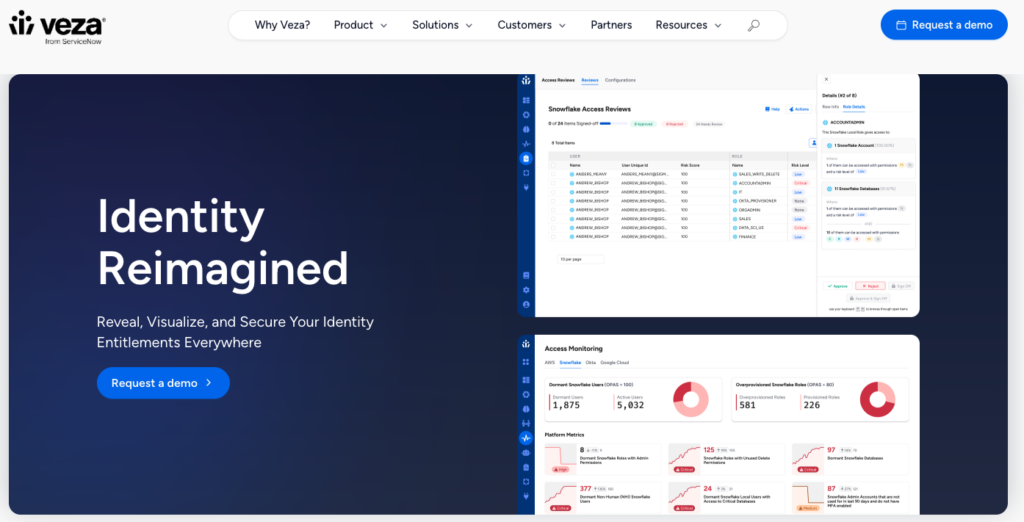
Veza is built around a single idea: show you who can do what, everywhere. Its Authorization Graph maps identities, roles, and permissions across cloud infrastructure, SaaS apps, data systems, and on-prem applications, giving security teams the authorization context they need to enforce least privilege at scale. Veza was recognized in the 2024 Gartner Peer Insights Voice of the Customer for IGA and achieved a 100% ‘Willingness to Recommend’ score, the only vendor in the report to do so. It is also a Leader in GigaOm’s 2025 Radar for Identity Security Posture Management.
Best for: Organizations that need deep, cross-system authorization visibility and want AI-related access risk addressed through a unified access model rather than siloed point solutions.
Worth knowing: Veza is newer to the market, and out-of-the-box connector coverage for less common applications is still growing. Several reviewers note they needed to work with Veza engineers to build custom connectors, though the support experience during that process is consistently praised.
Review: “Veza’s platform has provided visibility to our identities across applications that we did not previously have as readily available. It is quick to integrate and get insights. The product teams stay engaged with us as customers and are constantly improving and developing the product to meet customer demands.”
8. Salt Security
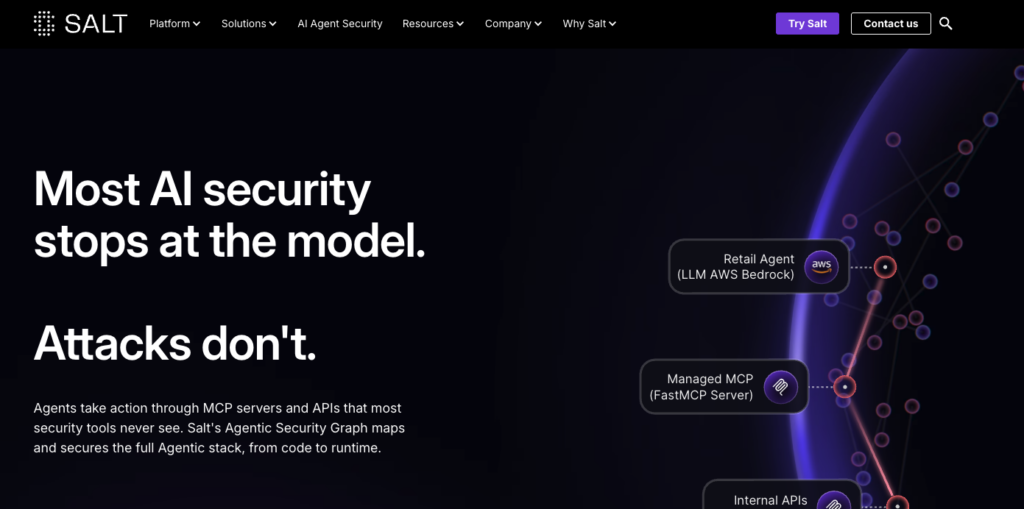
Salt Security is the right fit when your AI posture problem is really an API posture and runtime abuse problem. Its platform spans discovery, posture governance, and runtime threat protection across the full API lifecycle. The API Context Engine (ACE) uses behavioral analysis to detect business logic abuse that passes signature-based detection, a critical capability as AI-powered applications expose more complex API surfaces. Salt achieved the highest rating in the 2025 EMA PRISM Report for API Security.
Best for: Security teams rolling out AI-enabled applications and agent-driven services through APIs, where the biggest risks sit in API discovery gaps, business logic misuse, and attack chains that standard tooling misses.
Worth knowing: Salt Security is focused on APIs; it does not cover non-human identity governance or cloud posture management. Some reviewers note that integration depth with adjacent tooling could be broader, and that some advanced features are still maturing.
Review: “Platform provides deep API visibility and excels at detecting business logic abuse. Deployment was relatively straightforward using traffic mirroring, and insights were actionable early on.”
9. Cequence Security
Cequence is especially relevant where AI-facing applications are targets for automation, fraud, account takeover, or business logic abuse. Its Unified Application Protection (UAP) platform covers API discovery, posture evaluation, and real-time detection of sophisticated attack patterns. Cequence currently protects more than 10 billion daily API interactions and 4 billion user accounts. It was named a Leader in the 2025 KuppingerCole Leadership Compass for API Security and Management, and over 92% of Gartner Peer Insights respondents say they would recommend the platform.
Best for: Organizations with AI-enabled user journeys and APIs that face sophisticated automated misuse, especially bot traffic, credential stuffing, and fraud patterns that look legitimate at the application layer.
Worth knowing: Initial setup and tuning is time-intensive, particularly in large or complex environments. Getting the most from Cequence requires meaningful investment in onboarding and ongoing policy refinement. Dashboard performance under heavy load has also been flagged by some reviewers.
Review: “Cequence Security provides strong visibility into API traffic and helps identify automated bot attacks, abuse patterns, and potential API vulnerabilities. The platform is very useful for detecting abnormal behavior and protecting applications from credential stuffing, scraping, and other automated threats. It integrates well with existing security infrastructure and helps improve overall API security posture.”
10. Sweet Security
Sweet Security is not marketed as a pure AI-SPM platform, but it fits the category well for teams that need posture plus runtime context across cloud environments. Its Runtime CNAPP uses eBPF-based sensors to provide deep workload visibility with minimal performance overhead, detecting threats based on behavioral baselines rather than signatures. It correlates signals across cloud, applications, identity, and data into a single attack story, which dramatically reduces investigation time. Sweet was named both a Cloud Security Leader and CADR Leader in the 2025 Latio Cloud Security Report.
Best for: Teams that want to understand AI risk as part of a broader cloud attack-path problem, particularly when workload exposure, identity risk, and runtime telemetry all need to be correlated in one place.
Worth knowing: Reporting capabilities and alert customization are still maturing relative to more established CNAPP players. Sweet is strongest on the detection and response side, teams looking for deep compliance reporting or infrastructure-as-code governance may need to supplement.
Review: “The platform provides strong visibility into cloud runtime activity and helps us detect suspicious behavior and potential threats in real time. Deployment and integration with our AWS environment was straightforward and the product delivers valuable insights with low operational overhead. The support team has been responsive and knowledgeable, which has made onboarding and ongoing tuning much smoother.”
11. Wiz
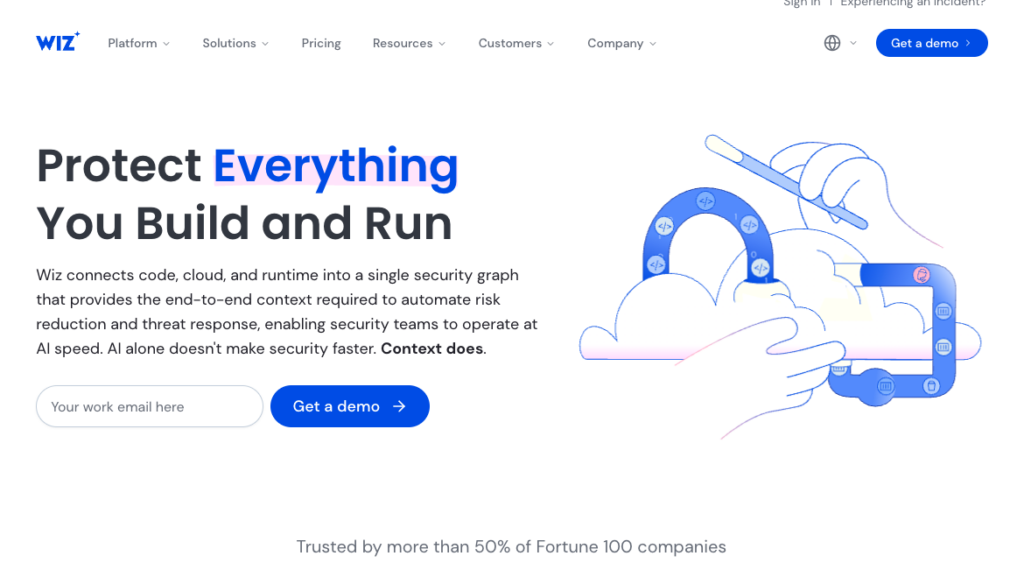
Wiz brings together cloud inventory, exposure-path prioritization, CIEM, CSPM, CWPP, Kubernetes posture, build-to-runtime visibility, and risk correlation across cloud and application layers. That matters when AI systems are embedded in cloud-native delivery pipelines and inherit risk from the surrounding environment. Wiz is the #1 ranked Cloud Detection and Response platform on G2 by customer satisfaction (Winter 2025), has 500+ verified reviews, and is trusted by more than 50% of the Fortune 100. Its agentless architecture means teams can often get meaningful visibility within hours of connecting cloud accounts.
Best for: Organizations that need an AI posture evaluated in the wider context of cloud exposure, workload risk, and developer remediation paths, and want a single platform that engineering teams can actually use daily.
Worth knowing: The volume of findings can create alert fatigue initially, and the platform requires tuning to surface the most actionable risks. Pricing is frequently cited as a barrier for smaller organizations. Note that Google’s proposed acquisition of Wiz is subject to ongoing regulatory review, which some buyers are factoring into long-term vendor decisions.
Review: “Wiz has been a game-changer for our hospital’s cloud security strategy. Its comprehensive visibility, real-time alerting capabilities, and user-friendly interface have markedly improved our ability to secure our cloud infrastructure.”
How to Choose the Right AI-SPM Solution
The most common mistake in this market is buying for the label instead of the real exposure. Before evaluating vendors, be honest about where your AI risk actually lives.
- If your risk sits in AI agents, service accounts, and machine access: start with identity governance. Apono, Clutch Security, Saviynt, CyberArk, Veza, and Teleport all address this layer, at different scales and with different implementation profiles.
- If your AI capabilities are shipped through APIs: put weight on API discovery, schema drift detection, and runtime abuse detection. Salt Security and Cequence Security are the strongest options here.
- If your concern is broader cloud exposure around AI infrastructure: look for platforms that correlate cloud posture, entitlements, workload telemetry, and attack paths. Sweet Security and Wiz serve that need well.
- If you want a single purpose-built AI-SPM platform from day one: FireTail is the most direct fit and the fastest to value.
The best AI-SPM program closes the gap between visibility and action: discover the assets, understand the access, prioritize the real risk, and route fixes to the teams that can actually reduce it.
Evaluation Checklist: What to Ask Every Vendor
Use this checklist to cut through product marketing and assess each platform on what actually matters in practice.
| Capability | What to ask in your evaluation |
| AI Asset Discovery | Can it inventory AI usage across code, cloud, users, APIs, and machine identities continuously, not just on demand? |
| Identity & Entitlement Context | Does it show ownership, usage history, and lifecycle status for service accounts, tokens, and AI agents, not just a list? |
| API & Workflow Awareness | Can it detect undocumented interfaces, spec drift, excessive data exposure, and abuse that looks like valid traffic? |
| Cloud & Runtime Visibility | Does it correlate posture findings with runtime telemetry and attack paths, or only report theoretical exposure? |
| Governance & Operational Fit | Does it integrate with your ticketing, SIEM, and reporting workflows, or generate findings that go nowhere? And does it extend governance beyond internal assets to the third-party AI tools and vendors connected to your infrastructure — or does it leave that as a checkbox exercise? |
| Deployment Complexity | What is the realistic time-to-value? Some platforms reward investment; others can be live in minutes. |
| Review Volume & Recency | Are third-party reviews recent and from organizations similar to yours in size and industry? |
Frequently Asked Questions
What’s the difference between AI-SPM and CSPM?
Cloud Security Posture Management (CSPM) focuses on misconfigurations and compliance issues in cloud infrastructure. AI-SPM goes further by specifically addressing the risks introduced by AI systems, including the non-human identities AI agents use, the APIs they call, the data they access, and the governance policies that should constrain them. Most organizations will use both, with AI-SPM sitting on top of or alongside their existing CSPM and identity tooling.
Do I need a dedicated AI-SPM tool, or will my existing stack cover it?
It depends on how much AI you’re running and how quickly. If you have a small number of well-understood AI integrations, your existing PAM, API gateway, and CSPM tooling may be sufficient for now. If you’re deploying AI agents, building AI-powered features into production APIs, or using third-party AI services at scale, you almost certainly have blind spots that general-purpose tools won’t surface. A purpose-built AI-SPM tool or a targeted addition to your existing stack is worth evaluating seriously.
What is a non-human identity, and why does it matter for AI security?
A non-human identity (NHI) is any machine, service, or automated process that authenticates to a system API keys, service accounts, tokens, certificates, and AI agents all fall into this category. NHIs are the primary way AI systems access data and infrastructure, and they tend to accumulate over time: over-privileged, stale, undocumented, and often owned by no one. Governing them is one of the most important and under-resourced areas in enterprise AI security right now.
How is AI-SPM relevant to the EU AI Act?
The EU AI Act’s high-risk enforcement deadline arrives on August 2, 2026, requiring organizations to demonstrate auditable AI security controls or face penalties of up to €35 million or 7% of global revenue. AI-SPM tools that provide continuous discovery, access governance, and policy enforcement can directly support the NIST AI Risk Management Framework requirements alongside the audit evidence the EU AI Act demands. If you operate in the EU or serve EU customers, this is a near-term driver worth factoring into your evaluation timeline.
What should I actually ask vendors in a proof of concept?
Start with discovery: connect the platform to your environment and see how many AI-connected assets it finds that you didn’t already know about. Then look at entitlement context, not just ‘what exists’ but ‘who owns it, when was it last used, and is it over-privileged.’ Finally, test the operational fit: does a finding in this tool create a clear path to remediation in the systems your team already uses? If the answer to any of those is ‘no,’ the platform will generate noise rather than reduce risk.
Compare These Solutions on Cybermatch
Want to evaluate these vendors side by side using consistent, buyer-focused criteria? Cybermatch lets security teams shortlist tools, compare categories in a structured way, and assess which platforms best match their AI, identity, API, and cloud security requirements without relying on vendor-supplied positioning.
Shortlisting vendors? Cybermatch lets you compare these tools side by side using consistent, buyer-focused criteria so you can cut through the noise and find the right fit for your environment.