APIs often fail in the quietest way possible: everything returns 200 OK while someone walks your data model with perfectly valid requests. If you’re building microservices, partner integrations, or internal automation, you’ve probably felt that anxiety—do we actually know every endpoint that’s exposed, and do our authorization checks hold for every object and every tenant?
A generic WAF can catch obvious payloads, but it won’t reliably spot an undocumented endpoint, schema drift, or an object-level authorization bug that only shows up when a real attacker chains calls together.
In Akamai’s 2025 State of Apps and API Security report, they observed more than 311 billion web application and API attacks in 2024, a 33% year-over-year increase—pressure that lands directly on the APIs you operate and the identity assumptions you make.
This guide explains what API security tools are, the main types, what to look for, and the benefits you should expect.
What are API Security Tools?
API security tools are products designed to help teams discover, assess, monitor, and protect APIs across development and production environments. They typically combine visibility (what APIs exist and how they behave) with security analysis (where the risks are) and, depending on the product, runtime detection and enforcement.
In practice, “API security” usually means three things happening continuously:
- Building an accurate inventory of endpoints.
- Understanding the contract (spec/schema) versus what’s happening in real traffic.
- Catching the issues that matter most in APIs—broken authorization, sensitive data overexposure, abuse and automation, and insecure configurations across gateways, services, and identity layers.
These fundamentals are often captured as an api security checklist so they don’t depend on tribal knowledge.
3 Types of API Security Tools
API security tooling tends to cluster into a few functional groups. Vendors often span more than one category, but these buckets help you match tools to your current gaps.
1. API discovery and posture management
The “visibility first” layer. These tools identify APIs across gateways, logs, traffic, and code, then build an inventory with ownership, exposure, and risk signals. This is often described as API security posture management. This category is often where teams start because you can’t secure what you can’t find, especially with shadow, zombie, and third-party APIs coming online faster than documentation can keep up.
2. API security testing
Focuses on finding vulnerabilities before they become incidents. That can include spec-based testing (OpenAPI/Swagger-driven), dynamic testing against running environments, and continuous testing that adapts as APIs evolve. In practice, teams usually end up aligning API testing with broader DAST coverage and release cadence.
The best testing tools understand authorization and business logic enough to surface issues like BOLA/IDOR—not just injection patterns or shallow misconfigurations.
3. API runtime protection
Sits in or near the request path or monitors it via mirrored traffic or service-mesh/agent telemetry to detect and sometimes block abuse in production.
This includes anomaly detection, bot and automation defense, credential stuffing and ATO patterns, token misuse, and endpoint abuse that looks “valid” unless you analyze identity, rate, sequence, and object-level access.
Most mature programs end up using a mix: posture to keep inventory clean, testing to prevent regressions, and runtime protection for the issues that only appear under real attacker behavior.
Key Features to Look For in API Security Tools
If you want an evaluation that doesn’t collapse into marketing comparisons, anchor on a few capabilities that are hard to fake in a real environment.
Discovery
Start with discovery you can trust. A good tool should find APIs from multiple signals (traffic, gateways, logs, repos, and sometimes cloud inventory) and keep the inventory current as endpoints change. It should also help you distinguish between “documented,” “observed,” “deprecated,” and “unknown” endpoints, because those statuses drive very different actions.
Schema and spec awareness
You want OpenAPI ingestion and validation, and you want drift detection that highlights when production behavior diverges from what engineering believes is deployed. This is where a lot of API incidents hide: fields added without review, response objects that grew over time, or a “temporary” endpoint that never got removed.
Identity and authorization context
API security without authorization (AuthZ) depth becomes glorified monitoring. You need visibility into caller identity (JWT/OAuth scopes, API keys, service identities), and the tool should help you detect object-level authorization issues and inconsistent enforcement across microservices and identity boundaries. This is also where zero trust assumptions tend to break down fastest, especially across services and tenants.
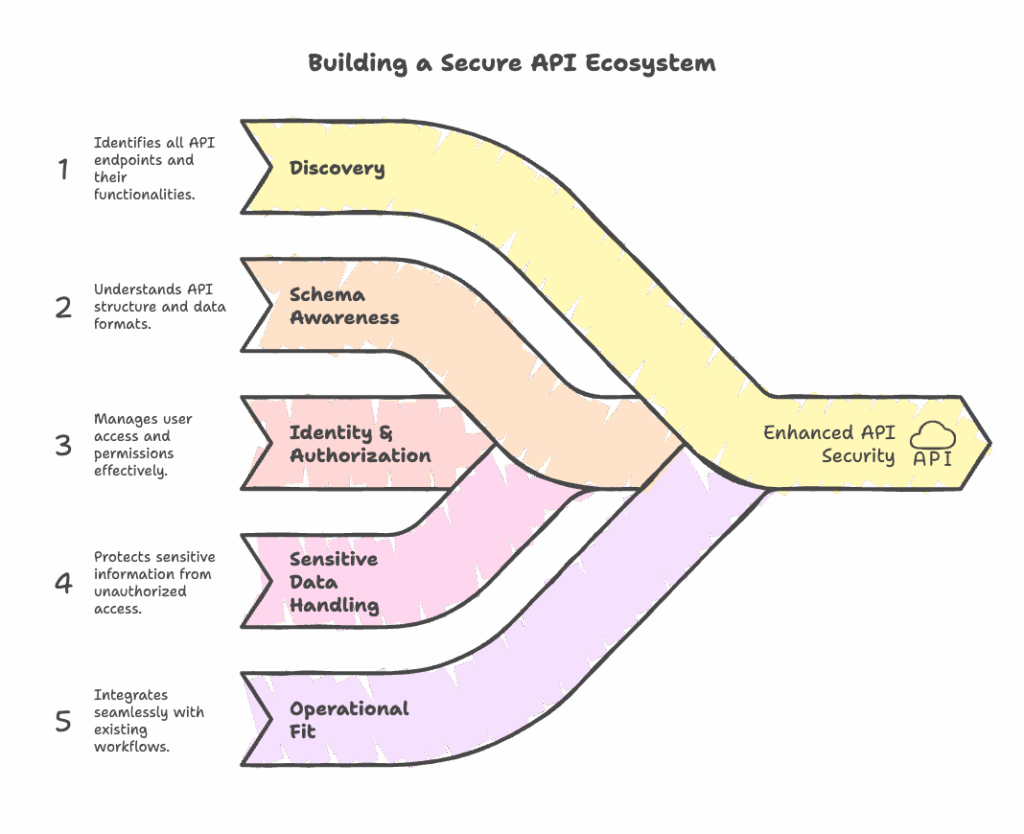
Sensitive data handling
It’s not enough to detect that an endpoint exists; you need to know if it’s exposing PII or secrets, whether it returns more than necessary, and whether those fields are being accessed in patterns that indicate misuse or exfiltration risk.
Operational fit
Key questions to ask:
- How does it deploy?
- Is it inline blocking, sidecar, gateway/plugin integration, agent in your services, or out-of-band monitoring via mirrored traffic?
- How well does it integrate with SIEM, SOAR, ticketing, and your existing alerting?
- When it finds something, does it provide evidence that an engineer can reproduce, fix, and verify?
A tool that’s powerful but can’t be operationalized will quietly become shelfware.
12 Best API Security Tools
1. ImmuniWeb

ImmuniWeb Neuron is oriented toward assessment and scanning, with API-relevant coverage as part of its broader application and infrastructure security evaluation approach. If your environment needs structured discovery of weaknesses with clear validation and remediation guidance, ImmuniWeb tends to be evaluated as a “find and triage” layer that can complement internal AppSec work.
Main strengths: Strong fit for scan-driven assessment with prioritization, validation support, and managed expertise wrapped around the findings.
Best for: Teams that need disciplined vulnerability discovery and triage, especially where internal AppSec bandwidth is constrained, and external validation is valuable.
2. Data Theorem
Data Theorem’s API Secure is positioned as a platform that blends API discovery and inventory, security testing, and active/real-time protection. The appeal here is consolidation: instead of stitching together multiple point products, you can cover posture plus detection and protection from one place—assuming it matches your deployment and data residency constraints.
Main strengths: Combines inventory/discovery with testing and active protection, with emphasis on continuous analysis across cloud, web, mobile, and API surfaces.
Best for: Security teams looking for a broad API security platform that spans visibility, assessment, and protection under a single operational model.
3. AppSentinels
AppSentinels leans into business logic and abuse detection. The platform language tends to focus on understanding application workflows, detecting anomalous and abusive patterns, and protecting APIs from misuse that doesn’t resemble “classic” web exploits.
Main strengths: Focus on business logic abuse and “valid-looking” malicious behavior, combining discovery and testing concepts with runtime monitoring for anomalous journeys.
Best for: Organizations that see meaningful abuse through APIs (fraud, automation misuse, logic exploitation) and want controls built around those realities rather than signature-only blocking.
4. Pynt

Pynt’s story is automation: generate and run API security tests continuously, based on API definitions and observed behavior. It emphasizes context-aware, attack-like test generation rather than generic fuzzing, which matters when you’re shipping frequently and don’t want API testing to become a manual bottleneck.
Main strengths: Automated, behavior-aware test generation and continuous testing model; strong alignment to shift-left workflows, CI/CD integration, and developer velocity.
Best for: DevSecOps teams that want continuous, context-aware API testing with minimal manual test design and tight feedback loops for developers.
5. Escape

Escape is frequently positioned around “modern stack” realities: microservices, cloud-native delivery, and GraphQL adoption. It blends API discovery with dynamic testing that targets business logic and authorization vulnerabilities, which is where many of the most damaging API issues actually live.
Main strengths: Discovery plus DAST with attention to business logic, GraphQL specifics, and authorization risks that sit beyond basic injection.
Best for: Teams that need discovery and dynamic testing in complex microservice ecosystems, especially where GraphQL and modern API patterns are in scope.
6. FireTail
FireTail emphasizes a hybrid approach: discovery signals from cloud, gateways, and repos; monitoring for risky patterns and misconfigurations; and policy enforcement options. It maps to how APIs really exist across layers: some issues are visible only in runtime traffic, others in specs, code, or cloud configuration.
Main strengths: Hybrid approach across cloud, gateways, and code with monitoring and governance; centralized logging, API security posture management, and enforcement options.
Best for: Organizations that want governance-grade visibility and policy control rather than only passive monitoring, especially when correlating API risk with broader cloud context.
7. Wallarm

Wallarm is commonly evaluated by cloud-native teams that need flexible deployment models and strong runtime protection for APIs and microservices. It is often discussed in the context of Kubernetes-friendly sidecars, ingress integrations, and cloud-native deployment patterns.
Main strengths: Strong runtime API protection orientation with integrated WAF capabilities and flexible, cloud-native deployment models.
Best for: Teams that need production-grade runtime protection and want deployment flexibility aligned to Kubernetes and modern cloud infrastructure.
8. Cequence Security
Cequence is typically associated with large-scale abuse, bot activity, and account takeover patterns that increasingly hit APIs directly. If your threat model includes automated credential stuffing, scripted abuse, or sophisticated bot behavior, Cequence is a top contender.
Main strengths: Strong focus on API abuse patterns, automation, and ATO-style threats across web and mobile channels.
Best for: Consumer-facing or high-volume digital services where API abuse, bot traffic, and large-scale automation are major risk drivers.
9. APIsec
APIsec is positioned around continuous API security testing driven by API specifications and attacker-like test automation. It is often considered when teams want repeatable, ongoing testing that can be wired into CI/CD and tuned for coverage of business logic and authorization cases.
Main strengths: Continuous, spec-driven testing model geared for evolving APIs; often evaluated for breadth across OWASP API Top 10 classes and AuthZ issues, with a focus on regression-safe test suites.
Best for: Teams that want robust, repeatable API testing that scales with release velocity and integrates cleanly into engineering workflows and pipelines.
10. Salt Security
Salt Security is positioned as an end-to-end API security platform spanning API discovery, posture management/governance, and runtime threat protection. It emphasizes behavioral/ML-driven detection using large-scale telemetry to spot “valid-looking” abuse patterns across APIs and users over time, alongside posture governance to enforce standards and reduce exposure from unknown or mismanaged endpoints.
Main strengths: Broad lifecycle coverage (discovery → posture governance → threat prevention) with strong runtime context and governance workflows.
Best for: Teams that already have meaningful API volume/complexity and need continuous discovery + governance plus production-grade detection/prevention for API abuse and attack chains.
11. 42Crunch
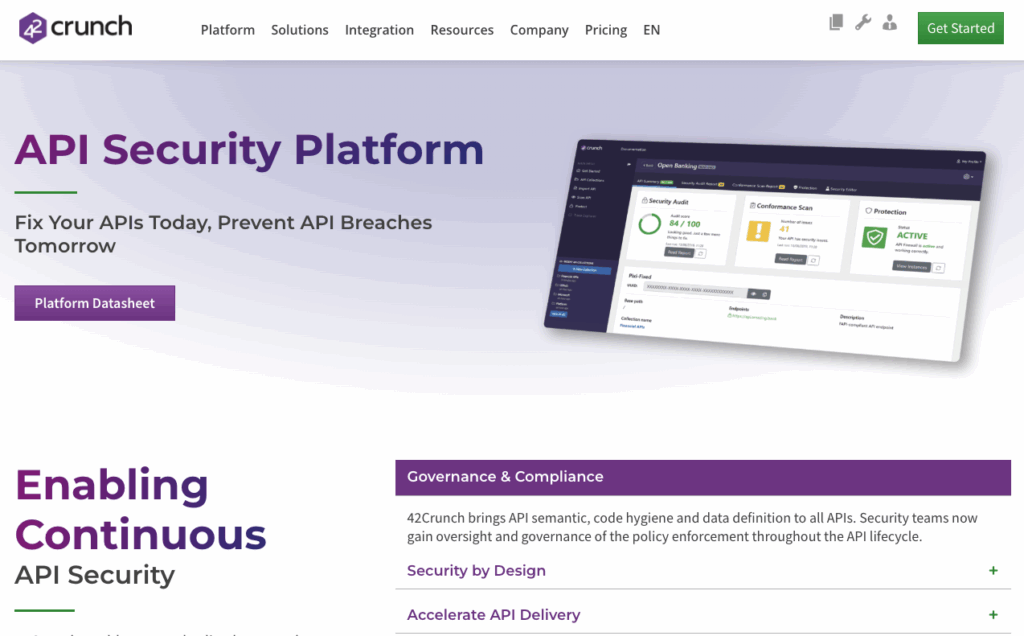
42Crunch is a spec-first (OpenAPI) API security platform built around baking security into the lifecycle: design-time auditing of OpenAPI definitions, dynamic conformance scanning against live APIs, CI/CD enforcement, and runtime protection. The differentiator is its “contract as control plane” approach—using OpenAPI not just for documentation, but as the anchor for security scoring, drift/conformance, and automated guardrails.
Main strengths: Strong OpenAPI-native workflow (audit/score → conformance scan → automated enforcement), plus developer-friendly entry points (IDE + CI/CD).
Best for: Organizations with decent OpenAPI hygiene (or the willingness to improve it) that want repeatable, policy-driven API security across design, build, test, and runtime.
12. Akto
Akto is an API security platform with an open-source core that focuses on continuous API inventory, security testing, and finding runtime issues by learning from real traffic patterns. It highlights broad test coverage (including OWASP API Top 10 categories) and “traffic-aware” testing to reduce noise and surface business-logic/auth issues more reliably.
Main strengths: Quick path to inventory from observed traffic, plus a large testing library and customization for continuous testing programs.
Best for: Teams that want practical visibility + testing without committing to a heavy platform upfront—especially if you value open-source flexibility and want to build a continuous API inventory and test cadence around production reality.
Quick Comparison: Best For…
| Tool | Primary Use Case | Key Differentiator |
| ImmuniWeb | Vulnerability Assessment | Managed scanning with validation, triage, and expert backing |
| Data Theorem | Full Lifecycle Platform | Active protection across mobile, web, and API from one hub |
| AppSentinels | Logic Abuse & Fraud | Deep analysis of stateful user journeys and business flows |
| Pynt | Automated Testing | “Autopilot” behavior-aware testing wired into CI/CD |
| Escape | Modern Stacks (GraphQL) | Business logic DAST with GraphQL and microservice depth |
| FireTail | Governance & Policy | Hybrid view (cloud + logs + spec) with centralized policy |
| Wallarm | Cloud-Native Protection | Integrated WAF & API security tuned for K8s and microservices |
| Cequence | Bot Defense / ATO | Handling high-volume automated abuse and credential attacks |
| APIsec | Continuous Assurance | Spec-driven, regression-friendly testing for logic & AuthZ |
| Salt Security | Runtime Protection + Posture | Behavior-driven detection + continuous discovery/governance for API attack chains |
| 42Crunch | Spec-First Governance + Testing | OpenAPI-led audit/scoring, conformance scanning, and policy enforcement across the lifecycle |
| Akto | Discovery + Continuous Testing | Traffic-aware inventory plus automated test coverage tuned to observed API behavior |
Closing thought: Pick the tool that matches your biggest “unknown”
If your biggest problem is “we don’t even know what APIs we have,” start with discovery and posture tools like FireTail or Data Theorem. If your biggest problem is “we ship fast and AuthZ keeps breaking,” prioritize continuous testing with Pynt, Escape, or APIsec. If your biggest problem is “attackers abuse our APIs in production,” runtime detection and protection from Wallarm, Cequence, or AppSentinels will matter most.
The right API security tool isn’t the one with the longest feature list, it’s the one that gives you an accurate inventory, catches authorization and data exposure issues you can actually fix, and fits how your environment ships and operates.Want to make the decision defensible? Use Cybermatch to compare API security tools side-by-side against transparent criteria, shortlist options, and export a comparison you can share with procurement and leadership.