Top 11 Software Composition Analysis Tools (By Category)
The flood of open-source code into software projects isn’t slowing down, and neither are the associated risks. What used to be a handful of hand-picked libraries is now a complex ecosystem of dependencies, transitive dependencies, and legal gray areas.
By Eyal Katz
59% of organizations have already experienced a supply chain–related security incident. These breaches often stem from deep, indirect dependencies that are hidden within modern software stacks. The exposure isn’t limited to build systems or package registries; it extends across sprawling dependency trees, transitive imports, and outdated third-party code. Ironically, the tools meant to help often contribute to the noise, surfacing every CVE regardless of its reachability or impact, and missing the context needed to prioritize real risk.
Whether you’re managing risk across hundreds of services or simply trying to keep your CI pipelines clean, the tools here are organized to reflect how teams work, not just what vendors list on their product pages.
What Software Composition Analysis Tools Need to Do
Most software composition analysis tools surface known vulnerabilities. The real problem is what happens next. A scan that lists every CVE (short for Common Vulnerabilities and Exposures) in your dependency graph, without context or prioritization, creates alert fatigue and teaches developers to disregard the results.
What Great Software Composition Analysis Tools Enable
- Actionable remediation guidance – not just CVE lists, but clear steps and safe upgrade paths
- CI/CD and workflow integration – feedback where developers already work
- Ownership and triage routing – alerts assigned to the right teams, with SLAs and metadata
- Policy enforcement – license rules, security gating, and usage controls
- SBOM generation – standardized output (SPDX, CycloneDX) for audits and traceability
The real value comes from filtering. Not every CVE in a transitive chain matters. Some packages are unreachable at runtime. Others are only loaded in test environments or behind feature flags. A capable tool should analyze call graphs, understand usage, and suppress issues that don’t affect execution paths. Reachability must drive prioritization. Tools should differentiate between high-severity CVEs that are actually exploitable and those that are inert in practice. Suppressing unreachable or unused vulnerabilities, especially in deep dependency chains, helps teams focus on real risk, not just raw volume.
Licensing deserves the same depth. Mismatches aren’t just legal noise; they impact redistribution, SaaS compliance, and IP risk. Tools should parse effective license terms, resolve dual-licensed code, and flag conflicts, such as AGPL, in closed-source systems. SPDX tags alone don’t suffice; boundary awareness and linkage models are also critical.
Ecosystem support should go beyond file parsing. Tools need to interpret lockfiles, such as go.mod, pom.xml, and Pipfile.lock, according to each package manager’s semantics to generate meaningful remediation guidance.
Software Composition Analysis Tool Breakdown
Not all software composition analysis tools solve the same problems. Some are built for fast feedback during development. Others are optimized for compliance, audit readiness, or managing risk across dozens of teams. In the sections that follow, we’ve grouped tools by use case, not just feature set, to help you choose based on where and how your team works.
Enterprise-Grade Suites
These platforms go beyond basic vulnerability scans. They’re built for organizations with formal risk frameworks, audit requirements, and multiple application teams. Expect deeper integrations, richer policy engines, and support for complex environments, but also a higher implementation overhead. These are tools for teams managing risk at scale.
1. Spectral by Check Point
Spectral by Check Point offers runtime-aware software composition analysis by correlating CVEs with cloud execution context, container activity, and live assets, enabling security teams to reduce alert fatigue and prioritize real threats.
Spectral by Check Point brings software composition analysis directly into developer workflows, flagging vulnerable dependencies, license risks, and exposed secrets in real time across code, pipelines, and Git platforms. It’s fast, policy-driven, and built to shift security left without adding friction. For teams that need to extend this visibility into production and correlate CVEs with cloud workload context, container activity, and runtime behavior. Spectral integrates natively with CloudGuard CNAPP, making it a powerful front door to broader, infrastructure-aware security coverage.
Best for: Centralized security teams mapping third-party risk to real infrastructure.
2. Endor Labs
Endor Labs prioritizes vulnerabilities based on code usage paths and OSS project health, helping engineering teams reduce noise and enforce policy against unused or risky dependencies.
Focuses on whether a vulnerable dependency is used. It analyzes code paths to determine if the affected function is called and considers OSS maintainer trust and project health in its prioritization. It can also block unused or unmaintained packages at the policy level, helping teams reduce technical debt and avoid legacy vulnerabilities that were never in use to begin with.
Best for: Engineering orgs looking to scale back noise and make OSS usage intentional.
Developer-Centric Tools
These software composition analysis tools are built for developers who want fast, meaningful feedback where they already work: inside Git platforms, editors, and CI pipelines. Each one performs some form of dependency analysis. What defines this category is tight integration and low friction, not central governance or policy enforcement.
3. GitHub Advanced Security
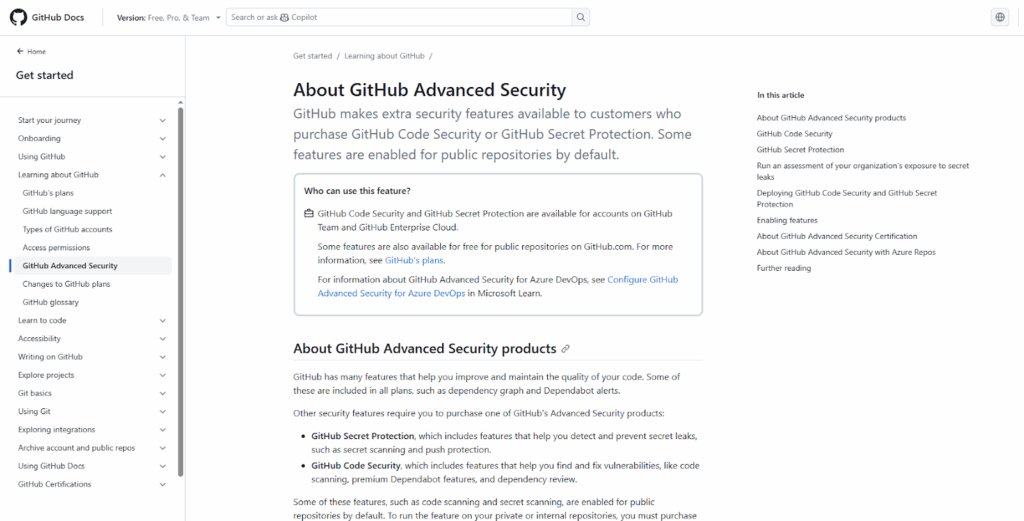
GitHub Advanced Security integrates SCA directly into the GitHub UI using Dependabot and CodeQL, allowing developers to identify and fix dependency risks without leaving their workflow.
Delivers software composition analysis through Dependabot and CodeQL. Dependabot scans your project’s dependency graph and raises pull requests to update vulnerable packages. Results are visible directly in the GitHub UI, helping developers fix issues without leaving their workflow. License detection is limited, and enforcement controls are minimal.
Best for: Teams working entirely inside GitHub who want automated dependency updates and basic vulnerability alerts.
4. GitLab Ultimate
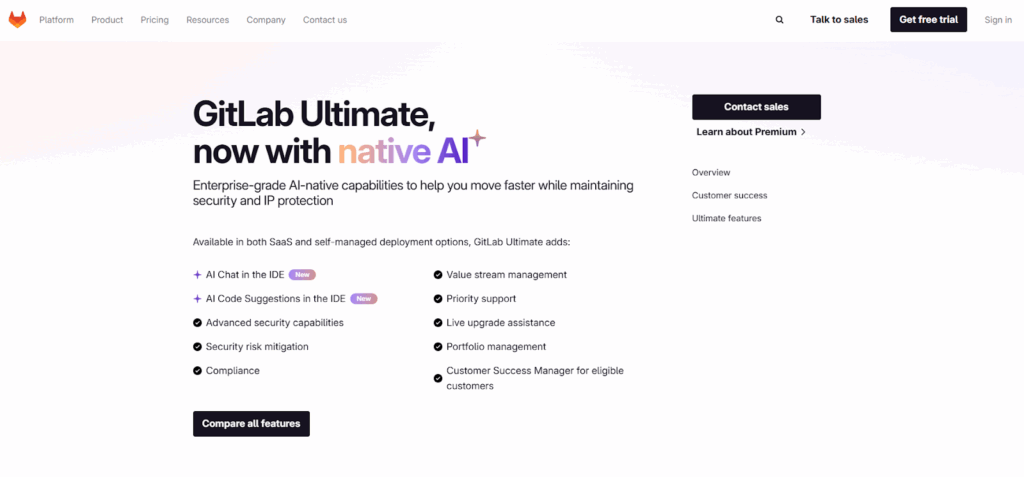
GitLab Ultimate enables in-pipeline software composition analysis by scanning dependencies during CI/CD, supporting early detection of CVEs in core ecosystems like npm and Maven.
Performs composition analysis by scanning dependencies as part of the CI pipeline. It parses manifest files and flags known vulnerabilities without requiring any additional configuration. The tool supports core ecosystems, such as npm and Maven, although its coverage is narrower than that of specialized SCA platforms. It aligns with broader DevOps-focused secure coding practices, where security checks are embedded early in the development lifecycle to reduce rework and surface issues before they escalate.
Best for: Teams that already use GitLab pipelines and want vulnerability scanning without extra setup.
5. Jit
Jit delivers security-as-code by embedding SCA into PR checks and CI pipelines, enabling DevOps teams to enforce policies automatically and secure code from the first commit.
Includes SCA functionality as part of a broader security-as-code framework. It integrates directly with CI workflows and PR checks, scanning for vulnerabilities and enforcing policy from the start of the development process. The tool emphasizes automation and security defaults rather than standalone scanning interfaces.
Best for: DevOps teams embedding security into pipelines and managing controls through code.
6. Socket.dev
Socket.dev inspects packages pre-installation for signs of malicious behavior, such as obfuscation and unauthorized network access, providing proactive supply chain risk detection.
Performs composition analysis at the package level before installation. It inspects behaviors such as obfuscated code, post-install scripts, and unexpected network access, surfacing risks that extend beyond known CVEs. The goal is to detect malicious or unsafe dependencies as they are added to the project. This philosophy aligns with the shift toward agentic pen testing solutions, which prioritize proactive security behaviors during development.
Best for: Teams that want to detect supply chain risk before it ever reaches the codebase.
Lightweight and Open Source Utilities
These software composition analysis tools focus on speed, simplicity, and automation. Most are CLI-based and easy to script into pipelines or internal developer platforms. While they may lack advanced policy engines or runtime prioritization, they deliver fast, transparent insights into third-party dependencies and are often used to generate SBOMs, scan containers, or support compliance workflows in custom tooling.
7. Grype (Anchore)
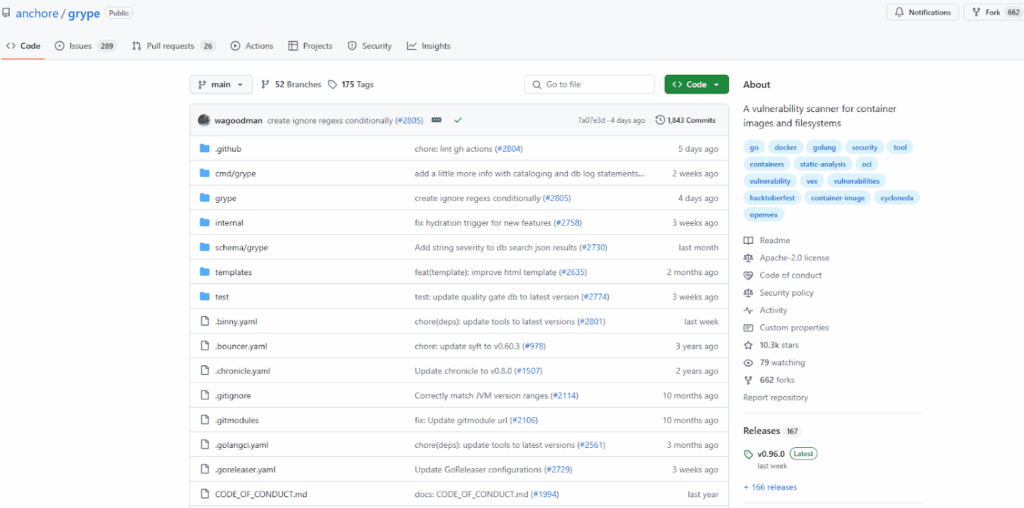
Grype is a fast CLI vulnerability scanner for containers, filesystems, and SBOMs, integrating easily into CI pipelines for real-time SCA with CycloneDX and SPDX support.
A fast command-line vulnerability scanner for container images, filesystems, and SBOMs. Grype integrates easily with CI pipelines and supports multiple input formats, including CycloneDX and SPDX. It’s instrumental in containerized or edge environments where other perimeter protections, such as cloud WAFs, may already be deployed. It draws from multiple vulnerability sources and can be integrated as part of a larger software composition analysis workflow, particularly when combined with Anchore Syft for inventory generation.
Best for: Teams that want to scan containers or package inventories as part of an automated pipeline.
8. OSV-Scanner (Google)
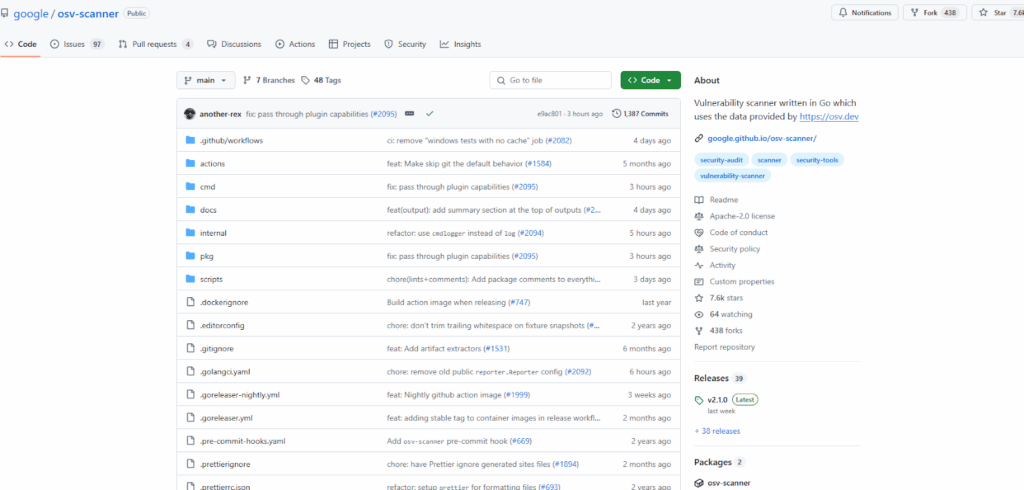
Google’s OSV-Scanner links directly to the Open Source Vulnerability database, offering commit-level precision in detecting known CVEs across modern ecosystems like npm, Go, and PyPI.
Connects directly to the Open Source Vulnerability (OSV) database, which standardizes vulnerability data for modern ecosystems like npm, Go, PyPI, and crates.io. It parses lockfiles and maps exact versions to known CVEs using commit-level precision.
Best for: Projects that want precise vulnerability detection tied to upstream package metadata.
9. OWASP Dependency-Check
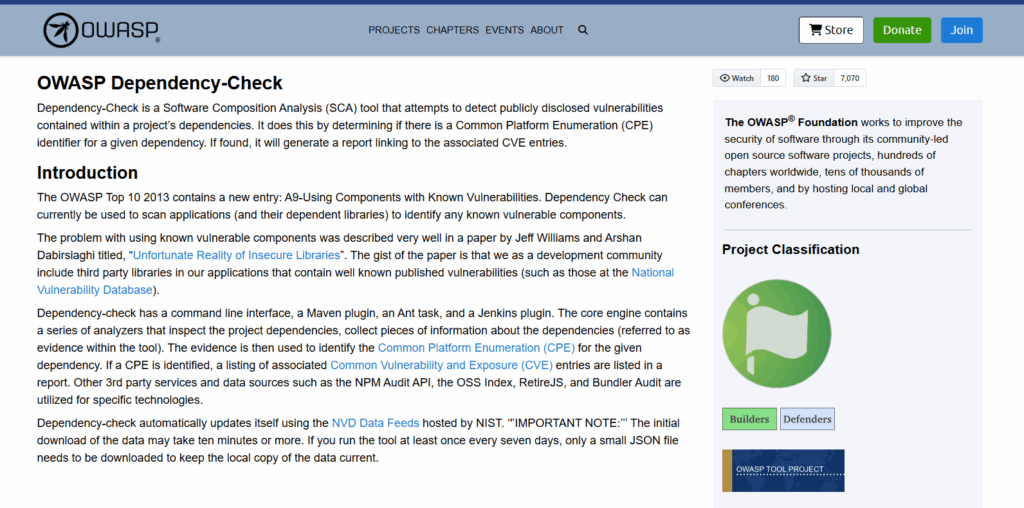
OWASP Dependency-Check is a mature Java-first SCA tool that scans JARs, WARs, and pom.xml files for CVEs.
A Java-first SCA tool that scans pom.xml, jar, and war files for known CVEs using multiple data sources. Dependency-Check predates many modern tools but is still widely used in enterprise Java environments. Its results can be exported in XML, HTML, or JSON, and it supports basic policy gating.
Best for: Java shops that need a mature, extensible scanner to integrate into their existing build systems.
SBOM Tools
These aren’t vulnerability scanners, but they play an essential role in the software composition analysis ecosystem. They standardize how dependency metadata is captured, shared, and audited. Most modern SCA tools either output or ingest SBOMs in one of these formats.
10. CycloneDX
CycloneDX is a lightweight, security-first SBOM format widely adopted in SCA workflows, enabling dependency visibility, auditability, and vulnerability correlation across CI pipelines.
A lightweight, security-focused SBOM format that is widely supported across SCA tools and CI ecosystems. It captures package metadata, dependency relationships, and known vulnerabilities. It can be used as both input and output in scanning workflows, making it a natural complement to efforts in evaluating model performance where software provenance and auditability matter.
Best for: Teams automating dependency tracking and vulnerability reporting across microservices.
11. SPDX
SPDX, managed by the Linux Foundation, provides a standardized SBOM format focused on license compliance and software traceability, critical for legal and supply chain audits.
An SBOM format maintained by the Linux Foundation, with a focus on license compliance, package provenance, and software traceability. SPDX is often used in legal reviews, supply chain audits, and procurement processes where open-source attribution and IP boundaries are more critical than vulnerability counts. These considerations are especially relevant in environments built around cloud-only SASE architectures, where deep software-level context may be overlooked.
Best suited for Organizations with legal or compliance teams that require complete lineage and license resolution.
How to Choose the Right Software Composition Analysis Tool
Choosing the right software composition analysis tool depends on your team’s development workflow, security maturity, and where friction typically occurs within your development process. The best tool isn’t the one that finds the most vulnerabilities; it’s the one that helps your team resolve meaningful issues without adding noise.
Software composition analysis isn’t about who can detect the most CVEs. It’s about which issues you can fix and how fast you can fix them. That means understanding real usage, reducing false positives, and making sure the right team sees the right issue at the right time.
Whether you’re working out of pull requests or managing risk across hundreds of services, the best SCA tool is the one that fits your workflow and clears your backlog.