Abstract:
A vulnerability assessment in an AI environment is a systematic process for identifying, analyzing, and prioritizing security risks across traditional infrastructure and AI-specific components, including language models, agents, vector databases, data pipelines, and non-human identities. As AI systems introduce new attack surfaces that traditional scanners often miss, organizations need assessment methods that account for model behavior, identity permissions, retrieval pipelines, tool access, and downstream automation.
Vulnerability assessment is one of the most mature practices in security. Scan the network, find the CVEs, patch the critical ones, repeat. For traditional infrastructure, that loop works reasonably well.
AI changes it. When you introduce language models, agents, vector databases, model APIs, and non-human identities into your environment, the list of things that can go wrong expands significantly, and most of them don’t show up in a CVE feed.
The numbers reflect this gap. IBM found that 13% of organizations reported breaches involving AI models or applications, and of that group, 97% lacked proper AI access controls. Most teams are scanning what they can see and missing what they can’t.
This guide walks through how vulnerability assessment needs to evolve when AI is in the stack, what to assess, where traditional tooling falls short, and how to build a program that actually covers the exposure.
What Vulnerability Assessment Actually Means in This Context
A vulnerability assessment is the process of finding, classifying, and prioritizing security weaknesses before attackers can exploit them. In most security programs, that means assessing infrastructure, applications, cloud environments, endpoints, networks, and identities for issues such as known vulnerabilities, misconfigurations, missing patches, exposed services, weak access controls, and risky permissions.
A good vulnerability assessment does more than produce a list of findings. It helps security teams understand which weaknesses matter most, what systems or data could be affected, how likely exploitation is, and what should be remediated first.
In traditional environments, this process is usually centered on assets with known software versions, stable interfaces, and vulnerabilities that can often be mapped to CVEs, configuration checks, or policy violations. That foundation still matters. AI systems still run on infrastructure, APIs, cloud services, containers, identity systems, and data stores that need to be assessed like any other technology stack.
Why AI Systems Need a Different Approach
Traditional vulnerability assessment works best when assets have known software versions, stable interfaces, and weaknesses that can be detected through CVEs, configuration checks, or policy rules.
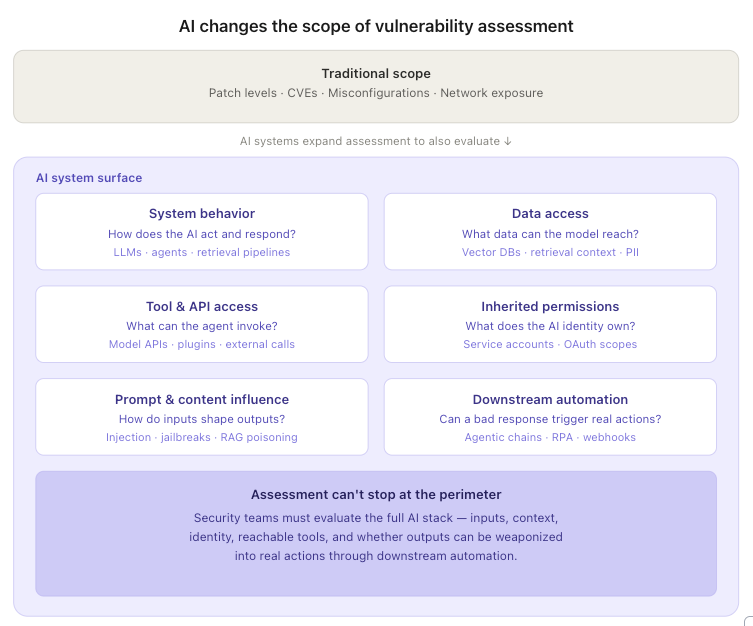
AI systems introduce a different kind of exposure. Their risk often depends on context: what data is retrieved, what tools the model can call, what permissions an agent inherits, how prompts are constructed, and how outputs are used downstream.
That creates weaknesses traditional scanners are not designed to detect. A prompt injection flaw may not map to a CVE. An over-permissioned agent may not appear in a network scan. A poisoned document in a retrieval pipeline may influence model behavior without changing the underlying infrastructure.
AI-aware vulnerability assessment therefore needs to test not just the systems AI runs on, but the behavior, permissions, data flows, and integrations that shape what the AI system can do.
5 properties of AI systems that conventional VA approaches miss
1. Non-deterministic behavior
Conventional vulnerability assessment usually assumes relatively stable interfaces and reproducible code paths. LLM applications are more context-dependent: outputs can vary based on sampling settings, conversation history, retrieved documents, tool outputs, memory, and permissions. That makes it harder to define a single “safe” baseline or detect when behavior has drifted in a meaningful way.
2. New attack surfaces with no CVE equivalent
Prompt injection, jailbreaking, model inversion, data poisoning, and adversarial inputs usually do not map cleanly to traditional CVE-based vulnerability management.
3. Non-human identities at scale
AI agents, service accounts, API keys, tokens, and automation identities proliferate quickly in AI environments. These non-human identities (NHIs) often carry standing privileges, have no clear owner, and are rarely included in standard vulnerability scans.
4. Dynamic, runtime-composed attack paths
An AI agent that can query a database, call an external API, and modify a file system doesn’t present a fixed attack surface; its exposure depends on what it does at runtime. Static scanning can’t capture that.
5. Supply chain exposure through models and integrations
Your AI system’s security depends partly on model providers, vector database vendors, embedding services, and MCP servers you don’t control, which makes supplier risk mitigation a core part of AI vulnerability assessment. Assessing those dependencies requires a different methodology than scanning your own infrastructure.
Traditional Vulnerability Assessment vs. AI-Aware Vulnerability Assessment
| AI VA Challenge | Traditional VA | Modern AI-Aware VA |
| Asset Coverage | Servers, endpoints, applications, network devices | All of the above plus models, agents, NHIs, vector DBs, model APIs, MCP servers |
| Vulnerability Types | CVEs, misconfigurations, unpatched software | Also prompt injection, data poisoning, model inversion, insecure tool chaining, NHI sprawl |
| Identity Scope | User accounts, service accounts in IAM | Includes AI agents, automation tokens, ephemeral identities, inherited permissions |
| Assessment Trigger | Periodic scans (weekly/monthly) | Continuous and triggered by AI deployment changes |
| Data Risk Assessment | Static data stores and databases | Also training data, retrieval-augmented content, inference inputs and outputs |
| Remediation Guidance | Patch, update, reconfigure | Also redesign prompts, restrict tool access, scope agent permissions, rotate credentials |
| Tooling | Scanners, SAST, DAST, CSPM | Above plus AI-SPM, NHI governance, runtime behavioral monitoring |
The AI Attack Surface: What You Actually Need to Assess
Before you can run a meaningful vulnerability assessment for AI, you need to know what you’re assessing. Most teams underestimate the scope.
A complete AI attack surface inventory covers seven layers:
1. Model Infrastructure
Whether you’re running open-source models on your own compute or calling third-party APIs, the model layer needs assessment. For self-hosted models: the serving infrastructure, container security, GPU access controls, and model artifact integrity. For third-party APIs: authentication, rate limiting, data handling terms, and exposure of sensitive inputs.
2. Agent Identities and Permissions
Every AI agent that can take actions on behalf of your organization is an identity that needs to be inventoried and assessed. What credentials does it hold? What systems can it reach? Who owns it? When was access last reviewed? Agents running under shared service accounts or inherited human permissions are especially high-risk.
3. Prompt Interfaces and Input Pipelines
Anywhere a user or external system can influence an AI model’s inputs is a potential injection point. This includes direct chat interfaces, API endpoints, retrieval pipelines, automated workflows, and any system where external content is fed into a model context window without validation, trust-boundary controls, retrieval filtering, or tool-use constraints.
4. Vector Databases and Retrieval-Augmented Generation (RAG) Systems
RAG systems rely on a retrieval pipeline that ingests, chunks, embeds, indexes, and retrieves external knowledge before the model generates a response. As teams evaluate the AI data platforms that support these pipelines, security teams need to assess how data movement, governance, semantic context, and access controls affect model behavior. That pipeline can improve answer quality, but it also expands the attack surface.
5. Tool Access and MCP Servers
AI agents that can call tools, such as file systems, databases, APIs, and code executors, have an attack surface defined by what those tools can do and what backend permissions they carry. This is where the distinction between RAG and MCP matters: RAG helps ground an AI system’s answers in retrieved knowledge, while MCP standardizes how agents connect to external systems to query data or take action. MCP servers that expose broad backend access effectively extend that attack surface to every connected agent. Assess tool scope, backend identity, and whether tool invocations are logged and approved.
6. Training and Fine-Tuning Data
If your organization fine-tunes models on internal data, the security of that training data matters. Data poisoning attacks introduce malicious patterns that persist in model behavior long after they’re injected. Assess data provenance, access controls on training pipelines, and integrity verification.
7. Output Pipelines and Downstream Systems
Model outputs that feed downstream systems — automated emails, code generation, infrastructure commands, database writes — are attack multipliers. A manipulated output that reaches an automated workflow without human review can cause real damage. Assess how model outputs are validated before they trigger downstream actions.
Key Vulnerability Types Specific to AI Systems
Prompt Injection
Malicious inputs that override a model’s instructions or manipulate its behavior. Direct injection comes from users interacting with the model. Indirect injection comes from external content the model retrieves or processes — a document, web page, or database record that contains embedded instructions. Indirect injection is harder to detect and increasingly common in agentic systems.
Jailbreaking and Instruction Override
Techniques that bypass safety guardrails to make a model produce outputs it’s been trained or prompted to avoid. These range from simple phrasing tricks to sophisticated multi-turn manipulations. For enterprise deployments, the risk isn’t just reputational — it’s that guardrail bypass can expose sensitive data or trigger unauthorized actions.
Data Exfiltration via AI Interfaces
AI models with access to sensitive data can become data exfiltration channels. A model with retrieval access to customer records, financial data, or internal documentation can surface that content in its outputs — intentionally through injection attacks, or unintentionally through poorly scoped retrieval configurations.
Model Inversion and Membership Inference
Given sufficient query access, attackers can sometimes extract memorized examples from training data or determine whether specific records were included — a technique known as membership inference. In practice, this is most relevant for smaller or fine-tuned models trained on sensitive internal data, customer records, or proprietary content. Large general-purpose foundation models are harder to attack this way, but fine-tuned variants running in enterprise environments are a realistic target.
Privilege Escalation Through Agent Chaining
In multi-agent workflows, one agent can call another, combining separate permission sets into a broader control path than any individual agent was authorized to have. If access decisions don’t account for the full delegation chain, attackers can use low-privilege entry points to reach high-privilege resources.
NHI Sprawl and Stale Credentials
AI deployments generate non-human identities quickly. Service accounts, API keys, tokens, and automation credentials accumulate without clear ownership or expiration. Stale NHIs with standing access are one of the most common and underassessed vulnerabilities in AI environments.
| The OWASP LLM Top 10 overlaps with some familiar AppSec concerns, but many of its core risks — including prompt injection, excessive agency, system prompt leakage, vector and embedding weaknesses, and data/model poisoning — are not covered well by traditional CVE-based scanning. |
Understanding the attack surface and the vulnerability types is the foundation. The next step is building an assessment program that actually covers them.

How to Build a Vulnerability Assessment Program for AI
The structure of a good program isn’t entirely different from a traditional one. It still needs asset inventory, risk prioritization, remediation workflows, and continuous improvement. What changes is the scope, the methods, and the tooling.
Step 1: Build a Complete AI Asset Inventory
You can’t assess what you don’t know about. Start by mapping every AI-related asset: models in use (hosted and third-party), agents and automation that use them, APIs and tool integrations, NHIs associated with AI workflows, data stores feeding retrieval pipelines, and MCP servers or integration middleware.
Most organizations discover significantly more AI exposure than they expected at this stage. Shadow AI — models and integrations deployed without central oversight — is common and often carries the highest risk.
Step 2: Classify Assets by Risk Tier
Not all AI assets carry the same risk. Prioritize assessment scope based on: data sensitivity (what can the asset access?), action capability (can it write, delete, trigger downstream systems?), external exposure (is it reachable from outside the perimeter?), identity privilege (what permissions does it hold?), and ownership clarity (does anyone actively maintain it?).
An AI agent with write access to a production database and no named owner sits at the top of your risk tier. A read-only assistant with access only to public documentation sits at the bottom.
Step 3: Apply AI-Specific Assessment Methods
Traditional scanning covers infrastructure-layer issues. For AI-specific vulnerabilities, you need additional methods:
- Prompt injection testing: systematically probe interfaces with injection payloads, including indirect injection through retrieved content
- Permission and entitlement review: map effective permissions for every NHI and agent identity, not just nominal roles
- Tool and API scope audit: assess what backend access each tool integration actually provides
- Data flow mapping: trace how sensitive data moves through the AI pipeline from retrieval to output to downstream systems
- Output validation review: assess where model outputs flow and whether they trigger automated actions without human review
Step 4: Prioritize by Exploitability and Impact
AI vulnerability findings should not be prioritized by severity labels alone. A prompt injection issue in a public-facing assistant with no tool access is very different from the same issue in an agent that can query customer records, modify tickets, or trigger production workflows.
Prioritize findings based on five factors: data sensitivity, external exposure, agent permissions, downstream action capability, and detectability. The highest-risk findings are usually those where an attacker can influence model behavior and convert that influence into data access, privilege misuse, or automated action.
Step 5: Remediate with AI-Appropriate Controls
Remediation for AI vulnerabilities looks different from patching a CVE. Depending on the finding, it might mean:
- Scoping agent permissions down to the minimum required for the defined task
- Adding input validation and output filtering to prompt interfaces
- Implementing just-in-time access for agent identities instead of standing privileges
- Restricting tool access to explicitly allowed APIs and data sources
- Adding human approval gates for high-impact agent actions
- Rotating long-lived credentials and implementing expiration policies
- Isolating MCP server backends so agents don’t share unrestricted connectors
Step 6: Establish Continuous Assessment
AI environments change faster than traditional infrastructure. New agents get deployed, integrations get added, and model versions change. A quarterly scan cadence isn’t sufficient. Build assessment triggers into your deployment pipeline so new AI assets are assessed before they reach production, and continuous monitoring covers behavioral drift in existing ones.
What Tools Support AI Vulnerability Assessment?
No single tool covers the full AI attack surface. Effective AI VA programs combine tooling across four functional areas.
AI Security Posture Management (AI-SPM)
Purpose-built platforms for discovering AI assets, assessing their risk posture, and enforcing governance policies. Tools in this category provide the discovery and inventory layer that traditional scanners miss for AI. They’re the closest equivalent to CSPM, but for AI-specific exposure.
Non-Human Identity (NHI) Governance
Platforms that discover, inventory, and govern machine identities across cloud, SaaS, and automation environments. Critical for assessing the identity layer of AI exposure — service accounts, tokens, agent credentials, and certificates. Effective NHI governance replaces standing access with just-in-time provisioning and enforces lifecycle controls.
API Security Testing
AI features reach production through APIs. API security tools assess these interfaces for documentation gaps, schema drift, excessive data exposure, and runtime abuse patterns. Particularly important when AI agents call external APIs or when AI capabilities are exposed to third parties through APIs.
Cloud Security Posture Management (CSPM) and Runtime Monitoring
AI systems inherit risk from the cloud environments they run in. CSPM tools assess infrastructure misconfigurations, excessive entitlements, and exposure paths. Runtime monitoring adds behavioral context — detecting when agents deviate from established baselines or when access patterns indicate compromise.
| Evaluating tools for your AI VA program? Compare AI security vendors on Cybermatch → |
AI Vulnerability Assessment Checklist
Use this checklist to evaluate the coverage of your current VA program or to scope a new one.
| Capability | What to Ask or Check |
| AI Asset Inventory | Have you mapped all models, agents, NHIs, APIs, vector databases, and MCP servers? |
| Shadow AI Discovery | Do you have a method for finding AI integrations deployed without central oversight? |
| Prompt Injection Testing | Are you testing both direct and indirect injection across all model-facing interfaces? |
| NHI Permission Review | Have you audited effective permissions for all agent identities, not just nominal roles? |
| Tool and API Scope Audit | Is tool access explicitly scoped, or do agents inherit broad backend permissions? |
| Data Flow Mapping | Can you trace how sensitive data moves through the AI pipeline from input to output? |
| Output Validation | Are model outputs validated before they trigger automated downstream actions? |
| Standing Privilege Review | Do any agents or NHIs hold permanent access that should be just-in-time? |
| Deployment Triggers | Is VA assessment integrated into your AI deployment pipeline, or only periodic? |
| Audit Trail Coverage | Can you trace specific agent actions back to identity, task, and approval context? |
Frequently Asked Questions
Do standard vulnerability scanners work for AI systems?
Partially. Standard scanners are useful for the infrastructure layer — compute, containers, APIs, cloud services, and underlying software. But they are not enough on their own. AI vulnerability assessment also needs to cover model behavior, prompt exposure, retrieval pipelines, agent permissions, tool access, and downstream automation.
Does the EU AI Act require vulnerability assessment?
The EU AI Act does not require it as a standalone named requirement, but high-risk AI systems must support documented lifecycle risk management, testing, and cybersecurity controls. Article 15 specifically expects resilience against AI-specific vulnerabilities such as data poisoning, model poisoning, adversarial examples, confidentiality attacks, and model flaws. A documented AI vulnerability assessment program can help produce evidence for these obligations. Applicability dates vary by system type, so organizations should validate the relevant timeline for their use case.
| Ready to assess your AI security posture? Explore AI security tools on Cybermatch → |