Network Detection and Response: An Essential Guide
Network Detection and Response (NDR) is a cybersecurity technology that monitors network communications to identify threats and support security investigations. Detection and investigation quality depend on the telemetry a platform can collect, the analytical methods it applies, and the evidence it preserves for analysts. Network visibility varies across on-premises, cloud, hybrid, and unmanaged environments, particularly when traffic is encrypted. Response capabilities range from passive monitoring and alerting to direct enforcement or containment through integrated security tools. Effective NDR evaluation requires comparing deployment coverage, investigation workflows, integration depth, response controls, and total cost against an organization’s security requirements.
By Eyal Katz

Endpoints are only one of many attack paths. Once inside an environment, attackers may pivot across user accounts, cloud workloads, and internal network paths to reach high-value assets or exfiltrate data. EDR provides deep visibility into endpoint activity, but it cannot always show how threats move across unmanaged devices, cloud environments, IoT infrastructure, and east-west network traffic.
Even as detection improves, the average breach lifecycle was still 241 days, highlighting how difficult it can be for SOC teams to connect signals spread across tools and environments. Network Detection and Response (NDR) helps fill that gap by analyzing network activity for suspicious behavior. This guide explains how NDR works, where it fits alongside EDR and XDR, and what security teams should compare when evaluating NDR platforms.
What Is Network Detection and Response?
Network Detection and Response (NDR) is a security technology category focused on continuously analyzing network traffic or network metadata to identify abnormal behavior, investigate suspicious activity, and support response.
Rather than relying only on known malware signatures, NDR products can model normal communication patterns and identify activity that deviates from those baselines.
Examples include:
- a compromised account scanning internal subnets
- a workload communicating with unusual external infrastructure
- repeated command-and-control beaconing
- an unexpected transfer of data between network segments
For a security operations team, the value is not simply another alert source. The useful question is whether the platform can show how systems communicated before, during, and after suspicious activity and provide enough evidence to determine what happened and what to do next.
Not every NDR product sees the same data. Some products emphasize full-packet capture, others rely primarily on flow metadata, and some combine network telemetry with identity, endpoint, DNS, cloud, and threat-intelligence context. Those differences affect both detection depth and day-to-day analyst workflow.
Why NDR Matters in Modern Enterprise Security
Endpoint telemetry is powerful when an agent is present and able to observe the activity. But security teams also need visibility into communications between systems, particularly across unmanaged devices, cloud workloads, IoT and OT environments, internal east-west paths, and other places where endpoint coverage may be incomplete. This becomes especially relevant when identifying shadow AI activity, where evidence may be spread across network, identity, endpoint, SaaS, and cloud systems.
NDR adds another detection surface: the traffic itself. Monitoring network behavior can expose internal scanning, unusual remote-service use, command-and-control traffic, DNS tunneling, unexpected service-to-service connections, and suspicious data transfers. It can also help analysts reconstruct an attack path when signals are spread across multiple systems.
That does not make NDR a replacement for endpoint security, SIEM, or XDR. In most environments, it is complementary: network evidence can reveal behaviors that host-centric telemetry misses, while endpoint and identity data can add the process, user, or device context that network evidence alone may not provide.
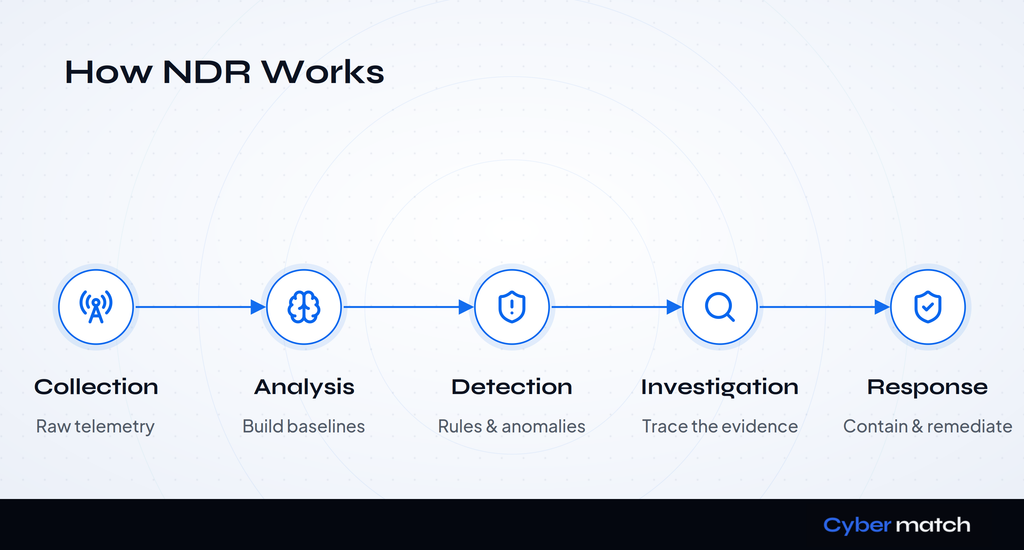
How NDR Works
1. Network Data Collection
NDR platforms ingest network telemetry from one or more sources. Depending on the product and deployment model, that can include packet captures, TAP or SPAN feeds, packet brokers, NetFlow/IPFIX records, DNS data, TLS metadata, virtual network traffic, cloud flow logs, traffic-mirroring services, and cloud APIs.
The collection model matters because it determines what evidence will be available later. A platform that retains packets can support different investigations from one that stores only flow records. Buyers should understand which telemetry is collected, where sensors must be deployed, how long data is retained, and what changes when traffic is encrypted.
2. Analysis and Behavioral Baselines
After collection, the platform has to separate normal communication from behavior worth investigating. Many NDR tools use behavioral analytics and machine-learning techniques to build baselines for hosts, users, services, protocols, and communication patterns.
The useful differentiator is not whether a vendor says it uses machine learning. Buyers should examine what evidence the product gives the analyst: why an alert fired, which baseline changed, what related entities were involved, and whether the detection can be tuned or suppressed without hiding legitimate threats.
3. Detection
Modern NDR products typically combine multiple detection methods. Signature and rule-based techniques can identify known malicious infrastructure, exploit behavior, and protocol patterns, while adjacent investigation workflows may use YARA rules to identify malware and hunt across file-based evidence. Behavioral or anomaly-based techniques can identify activity that does not fit the environment, including suspicious behavior with no known signature..
The balance between these approaches affects false-positive rates, explainability, and coverage. During a proof of concept, teams should evaluate both the breadth of detections and the quality of the evidence attached to each detection.
4. Investigation
Investigation is where NDR either reduces analyst effort or adds another console. Strong workflows let an analyst pivot from an alert into related flows, packets, hosts, identities, protocols, domains, and historical activity without manually reconstructing the event across multiple tools.
Useful capabilities can include packet-level evidence, session reconstruction, entity timelines, attack-path visualization, MITRE ATT&CK mapping, search across historical network data, and enrichment from identity, endpoint, or threat-intelligence systems.
5. Response
NDR response capabilities range from alerting and investigation workflows to automated containment. Depending on the product, response may happen directly—for example, by blocking traffic—or indirectly through integrations with firewalls, EDR, NAC, IAM, or SOAR platforms.
Automation should be evaluated in context. Automatically containing commodity malware may be low risk, while isolating a production database or critical service can be disruptive. Buyers should look for granular policy controls, approval-based actions, manual response options, and safeguards around high-impact assets.
NDR vs. EDR vs. XDR
NDR, EDR, and XDR overlap in detection and response, but they start from different telemetry and control points. The most useful comparison is not which category is ‘better’; it is which evidence and response mechanisms each technology can provide in your environment.
| Capability | NDR | EDR | XDR |
| Primary telemetry | Packets, flow records, DNS/TLS metadata, cloud network telemetry | Endpoint process, file, registry, memory, and host telemetry | Correlated telemetry across endpoint, network, identity, email, cloud, and other sources |
| Best suited to seeing | Lateral movement, C2, internal scanning, unusual service communication, exfiltration patterns | Malicious processes, scripts, memory activity, file changes, local privilege escalation | Multi-stage incidents spanning multiple security domains |
| Typical response | Traffic blocking, firewall/NAC actions, or downstream integrations | Process termination, quarantine, host isolation | Cross-domain playbooks and coordinated actions |
| Key limitation | Limited visibility into local process or memory state unless enriched from other sources | Limited or no direct host telemetry where an agent cannot be deployed | Value depends on the breadth and quality of native telemetry, integration depth, correlation quality, and consistency of data normalization across domains. |
Related Cybermatch category
XDR (Extended Detection and Response) correlates detection and response across endpoint, network, and cloud.
Compare XDR toolsCommon NDR Use Cases
- Internal reconnaissance and lateral movement. Attackers frequently have to discover systems and move between them after initial access. NDR can identify unusual SMB, RDP, RPC, Kerberos, database, or other internal communication patterns that suggest reconnaissance or pivoting.
- Command-and-control and outbound threat activity. Compromised systems often communicate with external infrastructure. NDR can detect persistent beaconing, unusual DNS behavior, suspicious destinations, and data-transfer patterns that warrant investigation.
- Unmanaged and agentless assets. NDR can provide visibility into devices where installing an endpoint agent is impractical or impossible, including some IoT, OT, network appliances, and legacy systems.
- Cloud and hybrid network visibility. Cloud workloads create dynamic east-west traffic and rely on virtual networking. As AI agents take more actions across cloud and SaaS environments, network telemetry may also need to be correlated with identity and activity context. Buyers should evaluate support for VPC/VNet flow logs, traffic mirroring, virtual sensors, Kubernetes, and multi-cloud environments.
- Behavioral baselining and threat hunting. Network history can help analysts identify relationships that should not exist, new communication paths, unusual protocol use, or changes in normal service behavior.
Passive Monitoring vs. Active Enforcement
Deployment mode has a major impact on what an NDR product can do during an incident. Some products observe mirrored traffic passively, some can enforce inline, and others rely on integrations to trigger containment elsewhere.
| Deployment model | What it can do | Buyer implication |
| Passive sensor | Observes mirrored traffic without sitting inline | Low disruption; direct blocking typically requires another control |
| Inline enforcement | Observes traffic and can block it directly | Faster direct response, but deployment and availability considerations matter |
| API/integration-based response | Triggers actions in firewall, EDR, NAC, IAM, or SOAR tools | Flexible, but response quality depends on integration depth and reliability |
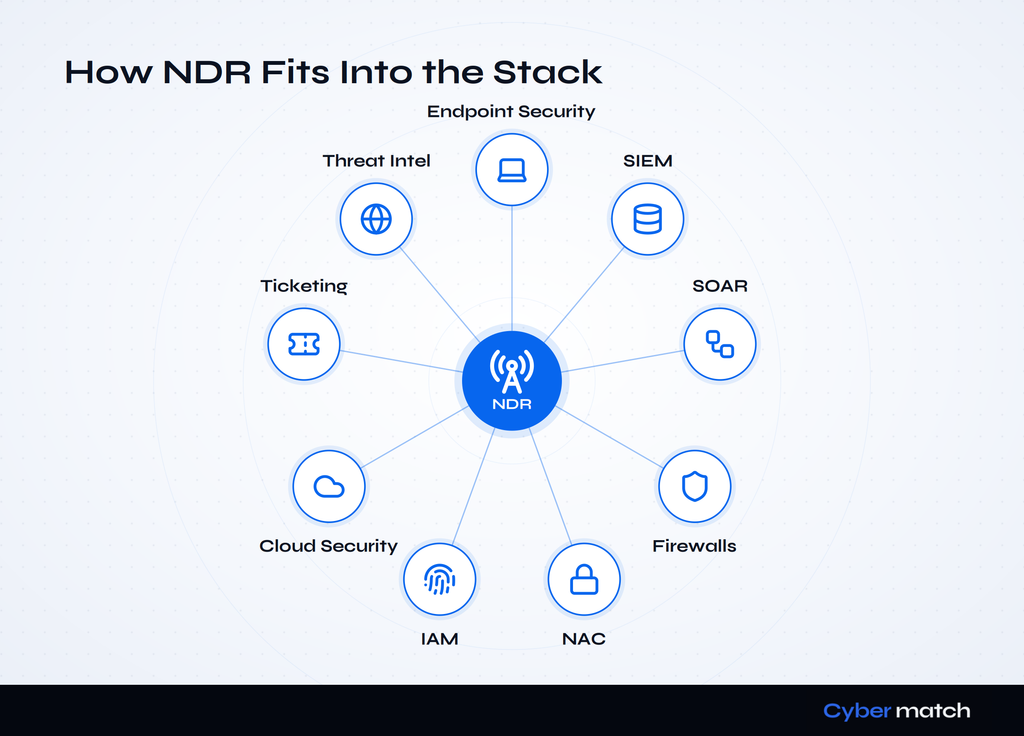
How NDR Fits Into the Security Stack
A network signal is most useful when it can be correlated with the rest of the security stack. NDR commonly integrates with endpoint security platforms, SIEM, SOAR, firewalls, NAC, IAM, cloud-security platforms, ticketing systems, and threat-intelligence services.
Different products take different approaches. Some provide deep native integrations inside a broader vendor ecosystem. Others are designed to be vendor-neutral and rely on APIs or prebuilt connectors. Buyers should test whether integrations preserve the evidence they need, whether response actions can be launched from the investigation workflow, and how much engineering is required to maintain those connections.
How to Compare NDR Platforms
NDR products can look similar at a category level while behaving very differently in production. A useful evaluation should move beyond generic claims such as ‘AI-powered detection’ and compare what the product actually sees, how it explains detections, and what the analyst can do next.
| Criterion | What buyers should compare |
| Network telemetry coverage | Packets, NetFlow/IPFIX, DNS, TLS metadata, cloud flows, east-west and north-south visibility |
| Deployment coverage | On-premises, AWS, Azure, GCP, Kubernetes, branches, remote sites, OT, and IoT |
| Encrypted-traffic analysis | Metadata-based techniques, decryption requirements, supported protocols, and performance impact |
| Detection methods | Signatures, rules, threat intelligence, behavioral analytics, ML, protocol analysis, and custom detections |
| Investigation depth | PCAP access, flow reconstruction, entity timelines, search, attack-path visualization, and historical lookback |
| Identity and asset context | Mapping traffic to users, accounts, hosts, workloads, business services, and asset criticality |
| Response mechanisms | Direct blocking versus actions through firewall, EDR, NAC, IAM, or SOAR integrations |
| Response controls | Automatic, approval-based, manual, and customizable playbooks; safeguards for critical assets |
| Integrations | SIEM, SOAR, EDR, firewall, NAC, IAM, cloud, ticketing, and threat-intelligence ecosystem |
| Retention | Packet, metadata, detection, and investigation-history retention and associated storage model |
| Tuning requirements | Baseline learning, exclusions, suppression, detection customization, and false-positive handling |
| Operational workflow | Alert triage, pivoting, case management, evidence presentation, search, and collaboration |
| Deployment effort | Sensor architecture, traffic mirroring, cloud permissions, scaling, and upgrade/maintenance requirements |
| Licensing and cost model | Throughput, sensors, assets, data volume, retention, add-ons, and infrastructure costs |
11 Questions to Ask NDR Vendors
- Which telemetry sources are required for your strongest detections, and which are optional?
- Do you analyze full packets, metadata, or both? What is retained and for how long?
- How do you handle encrypted traffic when decryption is unavailable?
- Can analysts see the evidence and logic behind a behavioral detection?
- How does the platform map network activity to identities, hosts, workloads, and business services?
- Which response actions are native, and which depend on third-party integrations?
- Can automated actions require approval for critical assets or high-impact changes?
- What cloud, Kubernetes, branch, OT, and IoT environments are supported?
- How long does baseline learning take, and how does the system handle routine environmental change?
- What tuning and maintenance does the platform typically require after deployment?
- How is the product licensed, and what costs scale with traffic volume, packet retention, sensors, or cloud ingestion?
Compare NDR Products Based on What They Actually See and Do
The NDR category is easy to describe at a high level and harder to compare in practice. One platform may retain packets and provide deep protocol evidence, while another emphasizes behavioral analytics over flow data. Some can block traffic directly; others rely on firewalls, EDR, NAC, IAM, or SOAR integrations for containment.
The right shortlist depends on your architecture, threat model, existing controls, and the amount of operational effort your team can absorb. Compare the telemetry each platform collects, where it can be deployed, how detections are explained, what evidence analysts receive, and how response actions are executed.
Cybermatch helps security teams compare NDR and other cybersecurity products side by side using transparent criteria, so they can build a shortlist for technical evaluation and procurement. Explore Cybermatch cybersecurity categories.