Abstract
- External Attack Surface Management (EASM) helps security teams continuously discover, monitor, and understand the internet-facing assets and exposures an attacker could find.
- AI raises the stakes for external visibility. Faster development, cloud change, APIs, and AI-driven attacker workflows make it harder to keep track of what is exposed.
- EASM fills a specific security gap. It provides an outside-in view that complements vulnerability management, CAASM, penetration testing, and other security controls.
- The right platform should turn discovery into action. Buyers should look beyond asset counts and assess discovery accuracy, ownership context, prioritization, integrations, and the practical value of AI features.
The asset you forgot about is still visible to an attacker.
Attackers now have less time between finding a weakness and trying to exploit it. In the 2026 Verizon DBIR, 31% of breaches began with vulnerability exploitation, making vulnerability exploitation the leading breach entry point for the first time in the report’s history.
Verizon also reports that generative AI is helping threat actors work faster across multiple attack techniques. EASM gives security teams an outside-in way to find internet-facing assets and exposures before an unknown system becomes an easy way in.
What is External Attack Surface Management (EASM)?
External Attack Surface Management is the ongoing process of identifying, monitoring, and reducing risk across assets exposed to the public internet. The UK National Cyber Security Centre describes EASM as a subset of attack surface management focused on online assets reachable from the internet.
The defining perspective is outside-in. EASM starts from what an attacker can observe rather than from an internal CMDB or scanner target list. It can surface forgotten subdomains, exposed development systems, new cloud services, unmanaged applications, and infrastructure inherited through subsidiaries or acquisitions.
Why EASM matters more in an AI world
Security teams still use EASM for the same core job: finding and monitoring what the internet exposes. AI changes the speed around that job.
Attackers can move faster. Threat actors are using AI to accelerate the exploitation of known vulnerabilities, potentially compressing the time defenders have to identify and remediate exposed weaknesses.
Deployment cycles are faster too. Rapid releases of APIs, cloud workloads, AI applications, model endpoints, agent interfaces, and temporary environments can create new public-facing services faster than security teams can update manual inventories. EASM does not secure AI models by itself. It answers a narrower question: what have we exposed to the internet, and how has that picture changed?
Ready to evaluate EASM platforms?
Compare EASM products against discovery, attribution, prioritization, and monitoring criteria.
Compare EASM toolsWhat counts as your external attack surface?
The external attack surface is broader than public websites. Depending on product coverage, EASM can map domains, IP addresses, web applications, APIs, cloud services, remote-access infrastructure, exposed services, and public test environments. Platforms also use signals such as DNS records and TLS certificates to expand, attribute, and monitor that footprint.
Ownership can be harder than discovery. Useful EASM helps determine whether a discovered asset belongs to you and who should remediate it.
AI adds another possible asset type. A public chatbot, model API, agent endpoint, or AI-enabled application can fall within EASM scope when the internet can reach it. EASM will not reveal every employee using an unapproved AI service inside the organization. External exposure discovery and AI discovery solve different visibility problems.
How EASM works: from discovery to remediation
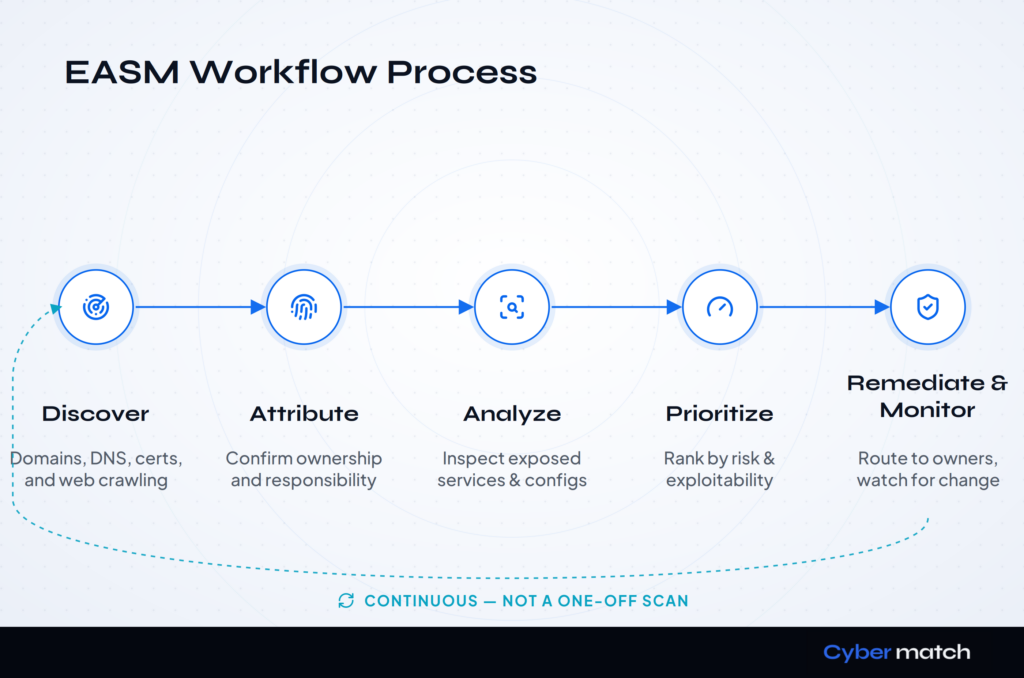
A common EASM workflow follows five steps.
- Discover. Enumerate internet-facing assets from organizational signals such as domains, DNS, certificates, IP relationships, service fingerprints, and web crawling.
- Attribute. Decide which assets belong to the organization and who owns them.
- Analyze. Inspect reachable services and configurations for exposures.
- Prioritize. Add asset, vulnerability, threat, or exploitability context to separate urgent findings from noise.
- Remediate and monitor. Route findings to owners and keep watching for new assets or meaningful changes.
The NCSC’s buyer guidance treats EASM as a continuous process rather than a one-off perimeter scan. Infrastructure, vendors, cloud projects, and business operations keep changing, so the external view has to change with them.
EASM vs. vulnerability management, CAASM, and automated pentesting
Their primary jobs differ even where capabilities overlap.
| Approach | Primary job | Typical starting point | What it adds |
|---|---|---|---|
| EASM | Discover and monitor internet-facing assets and exposures from the outside | Organization-related external signals | Unknown asset discovery, attribution, external change visibility |
| Vulnerability management | Identify, prioritize, and remediate vulnerabilities across assets brought into scope | Known or discovered assets, scanners, agents, integrations | Vulnerability lifecycle and remediation management |
| CAASM | Aggregate and normalize asset and security data to improve organizational asset context | Connected security, IT, cloud, and asset data sources | Broader asset context, data reconciliation, and control-gap visibility |
| Automated pentesting | Actively test defined targets for exploitable weaknesses; some platforms also validate or chain attack paths | Defined targets and test scope | Active exploitation evidence and attack-path validation |
Broader exposure management programs can combine several of these capabilities. An EASM platform may identify an exposed application, while an automated penetration testing platform may test whether an attacker can exploit a weakness and, depending on the platform, validate or chain that weakness into a broader attack path.
How to evaluate AI claims in EASM tools
The label “AI-powered EASM” tells buyers little about workflow value. Some EASM vendors describe machine learning or generative AI features for signal correlation, asset classification, change summarization, enrichment, or exposure prioritization. Those use cases vary by product, so verify them in the current documentation or a proof of concept.
- What data the AI uses?
- Which decisions it influences, and what evidence accompanies its output?
- Can analysts see why the platform attributed an asset to the company?
- Can they inspect or correct a risk score or classification?
Those answers matter because weak attribution can waste analyst time or leave real assets outside the program.
7 capabilities to look for in an EASM platform
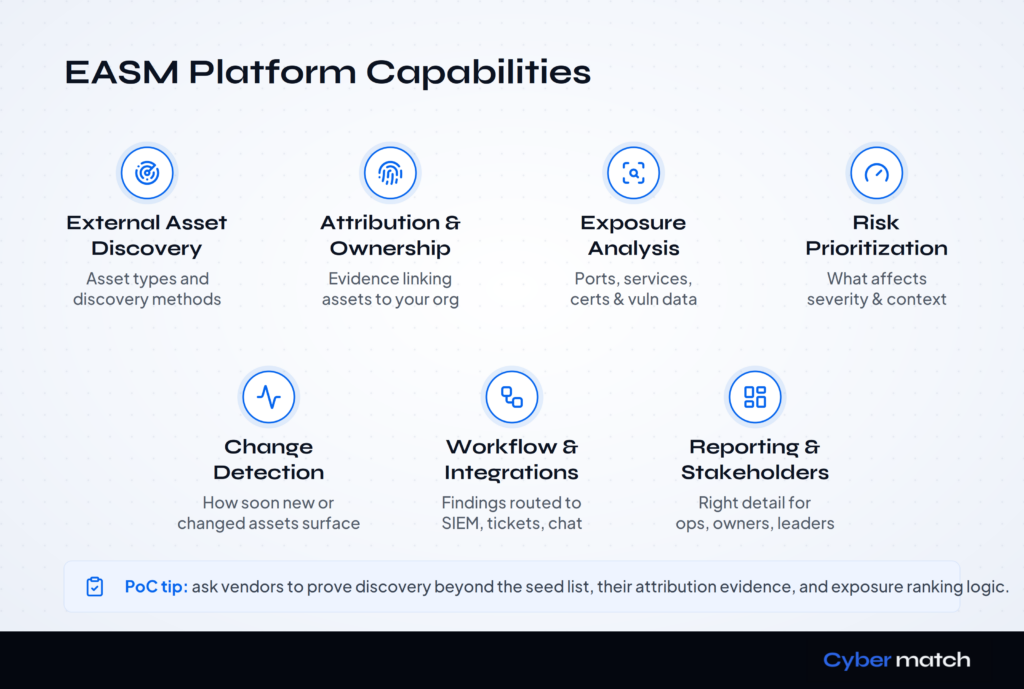
Coverage varies by product, so use these as evaluation dimensions rather than assumptions about every EASM tool. Cybermatch uses similar criteria to structure its EASM product category.
1. External asset discovery
Check supported asset types, discovery techniques, and how the platform expands from known assets to unknown ones.
2. Attribution and ownership
Look for evidence linking assets to your organization and workflows for ambiguous cases.
3. Exposure analysis
Verify what the product checks, such as ports, services, certificates, configurations, and vulnerability data.
4. Risk prioritization
Understand which factors affect severity and whether the platform incorporates business, exploitability, or threat context.
5. Change detection
Check how soon the platform surfaces new or changed assets and how teams tune alert noise.
6. Workflow and integrations
Confirm findings can reach the ticketing, SIEM, vulnerability management, or messaging systems used for remediation.
7. Reporting and stakeholder views
Make sure operators, asset owners, and leaders each get the level of detail they need.
During a proof of concept, ask vendors to show how the platform found an asset outside the supplied seed list, why it attributed that asset to your organization, and what evidence caused one exposure to rank above another. This tests the parts of EASM that determine whether your team can trust and act on the output.
How to make EASM useful after deployment
A discovery platform creates value when findings reach people who can act on them.
Set ownership rules for new assets, ambiguous attribution, and changes that need urgent attention. A new public admin interface deserves a different response from a routine certificate renewal.
Feed high-confidence findings into existing remediation workflows and measure whether teams resolve exposures, not how many assets the platform finds. Revisit discovery scope after acquisitions, new brands, cloud migrations, third-party changes, or AI deployments.
What EASM cannot replace
Security teams should treat EASM’s external perspective as a boundary.
Core EASM should not be assumed to provide authenticated application-testing depth or exploitability validation. Some platforms extend into vulnerability assessment or active validation, but buyers should treat these as product-specific capabilities rather than properties of the EASM category. It also cannot supply the internal asset, identity, and vendor context required for a complete third-party risk program.
AI-specific risks sit beyond that boundary, too. EASM may discover an internet-facing model endpoint or AI application, but it does not assess prompt injection, model behavior, or retrieval pipelines. AI agent access control addresses a different problem: what agents can access and do once they operate inside connected systems.
EASM FAQs
Is EASM the same as attack surface management?
No. EASM is the internet-facing subset of attack surface management. It concentrates on assets reachable from the internet, whereas the broader ASM concept can include internal and physical assets as well.
Does EASM replace vulnerability scanning?
No. EASM can discover assets and may identify vulnerabilities or external exposure signals, while vulnerability management provides the broader process for scanning, prioritizing, tracking, and remediating weaknesses across assets in scope. The two approaches complement each other.
Can EASM discover shadow AI?
Sometimes, within its visibility boundary. If the public internet can reach an unapproved AI application, model API, or agent endpoint and the EASM platform can associate it with your organization, the platform may surface it. However, the platform may discover the host, application, or API without necessarily classifying it as an AI service.
Internal employee use of third-party AI tools requires separate discovery and governance coverage.
Build visibility before the next exposure appears
EASM solves an external visibility problem. AI can accelerate attacker workflows, while increasingly rapid cloud, API, and AI deployment cycles raise the cost of stale asset inventories.
Buyers should focus on what the platform can see, how it attributes assets, why it prioritizes one exposure over another, and whether findings reach the teams that can fix them.
If you are evaluating this category, compare External Attack Surface Management products on Cybermatch against discovery, attribution, prioritization, monitoring, workflow, and reporting requirements that match your environment.